Who Needs and How to Apply for Rwanda Visa– Tourist Visa Entry Requirements, East Africa Tourist visa application

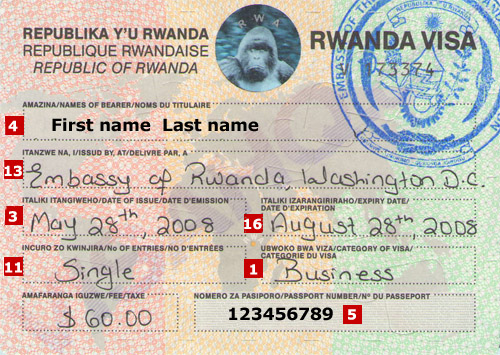
If you are a foreiegner visiting Rwanda, you should submit your visa application to the Rwandese embassy or diplomatic mission near you for processing.

Where this mission isn’t available, you can request for a visa acceptance letter online which you will present on arrival to get your visa upon payment of the visa fee  – $30.

Citizens of the East Africa Community can get a renewable 6 months’ visitor’s pass upon arrival for no fee.
Nationals of all African countries traveling to or transiting through Rwanda can   obtain a entry visa upon arrival without necessarily making prior application and pay for a visa ($30) where applicable.

In view of the existing bilateral agreements, citizens of the following countries can visit Rwanda without a Visa for a period of 90 days: Hong Kong, Democratic Republic of the Congo, Phillipines, Mauritius and Singapore.

Nationals of Australia, Germany, Israel, New Zealand, Republic of South Africa, Sweden, United Kingdom, and United States of America will be issued with entry visa valid for a period up to 30 days and pay for a visa ($30) upon arrival without prior application.

Nationals of the countries mentioned above not exempted from visa may also choose to get visa at Rwanda Diplomatic Missions (except the UN Mission in New York) or online.

Use the following link to apply for visa online:Click here

Try to do it 72 hours before and record your tracking number. A return ticket is mandatory for all those jetting into Rwanda. It is advisable to check with the nearest Rwandese consulate or visit: http://www.migration.gov.rw/ for more information.

When I say you MUST fill the form, I really mean it, many visitors are actually kicked out of the border for not doing it!

APPLICATION FOR THE EAST AFRICA TOURIST VISA (1 VISA = ENTRY TO RWANDA, UGANDA, KENYA)

To qualify for the East Africa Tourist visa, you must be a foreigner who wants to visit simultaneously the Republic of Kenya, Republic of Rwanda and Republic of Uganda for tourism.

The holder of the East Africa Tourist Visa shall enter from the country that issued the visa and move within the two other countries without applying for another visa or paying another visa fee.

The holder shall also be allowed to move out of the Republic of Kenya, Republic of Rwanda and Republic of Uganda; and return without having to pay for another visa. This will only be applicable in the period of 90 days.

Applications for this visa shall be lodged at any of the diplomatic representation of the Republic of Kenya, Republic of Rwanda and Republic of Uganda, at the Immigration Offices of the respective countries or online where applicable click here to apply online in Rwanda.

REQUIREMENTS:

*      One clear colored passport size photo with white background, recently taken without glasses, caps and scurf; (the photo should be attached to the application form by use of glue stick. Stapling and clipping the photo to the application form is not advisable).

*      A complete filled application form click here to download application form

*      An application letter addressed to the issuing authority of the concerned country

Transit single entry visas for up to 2 days are given at a cost of $30 at the same cost as the single entry tourist visa which is available for up to 90 days.
You will make the payment at the point where you enter the country. It is very important to remember that you need a confirmation letter (or a hotel confirmation, Tour operator invitation/ tour confirmation letter, copy of gorilla permit) to get a Rwanda visa and therefore you need to contact your contact in Rwanda or consulate in your country to get this document.

Please note that if you are planning to apply for resident/business or missionary multiple entry visas upon entry to Rwanda you will need to obtain police clearance from your home country. We advise you to obtain police clearance before travelling as this may often take longer than expected.

Entry Requirements – Passport Validity
You must hold a valid passport to enter Rwanda. Your passport must be valid for the proposed duration of your stay. No additional period of validity beyond this is required. However, it is always sensible to have a short period of extra validity on your passport in case of any unforeseen delays to your departure. You do not have to wait until your old passport expires to apply to renew it. Any time left on your old passport when you apply will be added to your new passport, up to a maximum of nine months.

However, Yellow fever vaccination certificates are in theory compulsory for entry or exit, but in reality are rarely requested.

Uganda Launches e-Visa application for Uganda Tourist visa applications

You can now apply for your Uganda tourist visa online with the new e-visa system.

All those who have guests, friends or relatives visiting Uganda, kindly advise them to apply for the Visas online. Soon they will be no issuance at the point of entry.
It is not yet however known if Uganda will continue for the time being with a  parallel process of Visa on arrival as has been the case all along and clarification is sought on this crucial issue.

If your visa or permit application is approved, it establishes that you are eligible for the approved visa or permit, but does not establish that your application is definitely approved.

Upon arrival to Uganda (at the selected point of entry) or to the Immigration Office Headquarters, you will be inspected by an Immigration Officer who may determine if your application is finally approved. All information provided by you, or on your behalf by a designated third party, must be true and correct. A visa or permit application approval may be revoked at any time and for any reason, such as new information influencing eligibility. You may be subject to administrative or criminal penalties if you knowingly and willfully make a materially false, fictitious, or fraudulent statement or representation in an electronic visa or permit application submitted by you or on your behalf.

Please indicate you have read and understand the information provided above.

The process would work as follows:

1) Anyone arriving from 01st June 2016 who require Visas must have applied online and on completion and submitting the application intending travelers are to receive a bar coded email notification.
2) On arrival at any border post, airport or land borders, that email must be presented and the bar code will be scanned into the immigration system. A Visa sticker will then be printed, including a scanned in picture and will be inserted into the passport on payment of the respective Visa fee.
3) For any Visa extensions, again the process is due to be completed on line though it is thought that anyone in Kampala may apply in person at the Immigration Headquarters at the Ministry of Internal Affairs.
4) These applications will be for regular single entry Visa, the common East African Tourist Visa (covering besides Uganda also Kenya and Rwanda), multiple entry Visa and Business Visa.
5) Access to the application platform can be found at www.visas.immigration.go.ug

In a related development will applications for special passes and work permits also from 01st of June onwards be done online.

Relevant statements from the Ministry of Tourism, the Uganda Tourism Board and the Ugandan private sector are expected to be issued in due course further explaining the modalities of these transactions.

Try it and let us know how it works.

Who needs yellow Fever Vaccination Certificate to Rwanda, Who is exempted from the Immunization certificate?

Who needs yellow Fever Vaccination Certificate to Rwanda, Who is exempted from the Immunisation certificate?

While Rwanda is Yellow Fever free, following the current active outbreak of Yellow Fever in

Angola and the documenting of imported cases in some countries, the Rwandan Ministry of Health is implementing measures to prevent the import of Yellow Fever cases and therefore protect the health of residents and visitors.

The following instructions are delivered to inform public and travelers:

1. To enter in Rwanda, a Yellow Fever vaccination certificate is not required for travelers (Residents/ Non-Residents) coming from Yellow Fever non-endemic countries and without an active transmission outbreak of Yellow Fever.

2. To enter in Rwanda, a valid Yellow Fever vaccination certificate is mandatory for travelers (Residents/ Non-Residents) coming from Yellow Fever endemic countries1 and countries2 with active Yellow Fever transmission outbreaks.

3. All residents travelling to Yellow Fever endemic countries1 should be vaccinated at least 10 days before travelling.

4. For travelers (Resident/ Non-Resident) coming from an active Yellow Fever transmission outbreak country2 or travelers who have recently visited (within 24 days) an active Yellow Fever transmission outbreak country2 the following instructions will be applied:

 Yellow Fever endemic countries1: Angola, Argentina, Benin, Bolivia Plurinational, Brazil, Burkina Faso, Burundi, Cameroon, Central African Republic, Chad, Colombia, Congo, Côte d’Ivoire, Democratic Republic of the Congo, Ecuador, Equatorial Guinea, Ethiopia, French Guiana, Gabon, Gambia, Ghana, Guinea, Guinea-Bissau, Kenya, Liberia, Mali, Mauritania, Niger, Nigeria, Panama, Paraguay, Peru, Senegal, Sierra Leone, South Sudan, Sudan, Suriname, Togo, Trinidad and Tobago, Uganda, Venezuela.

 Active Yellow Fever transmission outbreak country2: Angola

If you would like to get a waiver of the vaccination certificate and enter Rwanda, there are generally two ways to get and present an exemption. The first is to go to a registered provider of the Yellow Fever vaccine and have them write the exemption on the International Certificate of Vaccination or Prophylaxis (ICVP) card (Yellow Card). The other way is to have your physician write the exemption on practice letterhead. The following link to the UK Health Service contains a further link to a template for such a letter of medical exemption.

Planning a gorilla trek in Uganda, what to consider – How to plan your gorilla tracking program, transport to Bwindi, accommodation, how to book the gorilla permits, cost of the gorilla tour.

To track the gorillas you must have a pre-booked gorilla tracking permit (each costs US$600) . Since the gorilla parks are located far away from the airport you arrive from you will need transport (4×4 advisable) to reach the park. The drive from Kampala/ Entebbe to Bwindi takes about 9 hours. This means that if you are tracking gorillas in Uganda you will need at least 3 days to the gorilla trek: One day travelling to the park, another day tracking the gorilla, and the third day driving back to Kampala/ Entebbe.

To book your gorilla permit, you will need to either contact the relevant country agency to book the gorilla permit (Uganda Wildlife Authority for Uganda) or book the permits through a local tour agency like us. Please note that gorilla permits are only confirmed by paying for them in full. So, you will need to send money for the permits in full to get your confirmation ad ensure that you take care of the bank charges involved to avoid disappointment.

If you are hoping to travel in the busy seasons of December to March or June to September, be aware that permits for  many dates could sell out 4 months to the tracking  and you may not be able to get the gorilla permit for the days period you wish to travel.  These permits are not at the Uganda Wildlife Authority but with local tour agents. We can assist our clients to get such permits when contacted.

If you arrange the gorilla permit on your own, please ensure that you pick it from the booking office in Kampala before travelling to Bwindi. You must present your gorilla permit and passport on the gorilla tracking day to be allowed on the gorilla trek. In case your permit is booked through a tour agent and you are taking the tour with them you may not necessarily need to think about getting the permit from them but if you are not taking the full gorilla tour with them, consider getting your permit before travelling to Bwindi.

Planning your Transport to the Gorilla Trek in Rwanda and Uganda:

You will definitely require a 4×4 vehicle to go to the gorilla in Bwindi. You need a 4×4 vehicle to navigate the rough pot-holed roads which often get tourists stuck for hours during rainy seasons. You may be able to hire a vehicle for US$100 per day excluding the fuel but including the driver costs. In Uganda’s case, Gorillas and Wildlife Safaris offers transfers for US$510 for the 3 days (including vehicle, fuel, driver allowances for 3 days tour).
Alternatively you may take public buses to a nearby town but you will definitely have to find a cab (preferably 4×4 and usually costs $100 a day without gas fuel) to ferry you to the gorilla trek trail start an back to your hotel.

You need to report to the park registration office at 7:30AM. So whatever method you choose, make sure that it is reliable  – if you don’t turn up at the appointed time you risk invalidating your gorilla tracking permit and having to pay again.

The gorilla tracking time is very unpredictable and you may as well take the entire day. So have your accommodation booked for the night after your trek as well. For this same reason also have with you a packed lunch for the day, plenty of drinking water, rainproof clothing (you are trekking through a rainforest and any day it can rain).

Planning Your Accommodation during your Gorilla Trek tour

In Uganda, the accommodation you choose will depend on the gorilla permit you book being that the available 11 gorilla families that tourists visit in Bwindi range over a wide area. Please have a look at the page www.gorillasandwildlifesafaris.com/Bwindi GorillaTourAccommodationLodgesHotelsCampsitesUganda.htm for more details about which accommodation you will need to book for each different gorilla family in Bwindi.

Hiring Porters and Walking Sticks for the Gorilla Trek

Usually there are porters for hire (at $15 each) at the park offices and walking sticks (at $5). Do not overestimate your strength; you may certainly need either or both of these. So put it in high consideration to hire one. Besides, it’s another way of giving back to the communities.

Joining your gorilla trek with other tours/ excursions

Uganda offers a variety of tours you can join onto your gorilla trek. You can choose to do these safari excursions before or after the gorilla trek. Here are a couple of the many tour options that combine gorilla treks with amazing wildlife and scenery viewing.

How to Plan your Gorilla Trek/ Tracking Tour and Safari in Uganda & Rwanda

Uganda safari packages tours

How to plan your gorilla trek in Rwanda and Uganda, what to consider – planning your program, transport, accommodation, and other activities for the gorilla trek.

Gorilla tracking can only either be done in Uganda’s Bwindi Impenetrable National Park and Mgahinga Gorilla National Park or Rwanda’s Volcanoes National Park. To track gorillas you must have a pre-booked gorilla tracking permit (US$600 in Uganda and US$1500 in Rwanda per person). Since the gorilla parks are located far away from the airport you arrive from you will need transport (4×4 advisable) to reach the park.

In Uganda you will need at least 3 days to the gorilla trek: One day travelling to the park, another day tracking the gorilla, and the third day driving back to Kampala/ Entebbe.

In Rwanda you need only about two hours to get from the Airport to the Park and you can even do a 1-day tour.

To book your gorilla permit, you will need to either contact the relevant country agency to book the gorilla permit (Uganda Wildlife Authority for Uganda or ORTPN for Rwanda) or book the permits through a local tour agency like us. Please note that gorilla permits are only confirmed in either cases by paying for them in full. So, you will need to send money for the permits in full to get your confirmation.

If you arrange your own gorilla permit, please ensure that you pick it from the booking office in Kigali/ Kampala before travelling to the gorilla park. You must present your gorilla permit and passport on the gorilla tracking day to be allowed on the gorilla trek. In case your permit is booked through a tour agent and you are taking the tour with them you may not necessarily need to think about getting the permit from them but if you are not taking the full gorilla tour with them, consider getting your permit before travelling to the Park.

Planning your Transport to the Gorilla Trek in Rwanda and Uganda:

In both Rwanda and Uganda, you will require a 4×4 vehicle to go to the gorilla parks. Much as you can travel in just two hour to access Volcanoes National Park in Rwanda on smooth surfaced roads, you will definitely require a raised 4×4 vehicle to move from the Volcanoes Park Headquarters to the gorilla trek trail-head – the roads are rough, full of rocks and not easily navigable for a small car.
For Uganda, you also need a 4×4 vehicle to navigate the rough pot-holed roads which frequently get clients stuck for hours during rainy seasons. In both cases, you may be able to hire a vehicle for US$100 per day excluding the fuel but including the driver costs. In Uganda’s case, Gorillas and Wildlife Safaris offers transfers for US$520 for the 3 days (including vehicle, fuel, driver allowances for 3 days tour).
Alternatively you may take public buses to a nearby town but you will definitely have to find a cab (preferably 4×4 and usually costs $100 a day without gas fuel) to ferry you to the gorilla trek trail start an back to your hotel.

In Rwanda your gorilla permit requires that you be at the park headquarters at 7:00 AM or before for the gorilla tracking activity. In Uganda, you need to report to the park registration office at 7:30AM. So whatever method you choose, make sure that is is reliable  – if you don’t turn up at the appointed time you risk invalidating your gorilla tracking permit and having to pay again.

The gorilla tracking time is very unpredictable and you may as well take the entire day. So have your accommodation booked for the night after your trek as well. For this same reason also have with you a packed lunch for the day, plenty of drinking water, rainproof clothing (you are trekking through a rainforest and any day it can rain).

Hiring Porters and Walking Sticks for the Gorilla Trek

Usually there are porters for hire (at $15 each) at the park offices and walking sticks (at $5). Do not overestimate your strength; you may certainly need either or both of these. So put it in high consideration to hire one. Besides, it’s another way of giving back to the communities.

Planning Your Accommodation during your Gorilla Trek tour

In Rwanda, you can stay in at any hotel in Ruhengeri town, Kinigi town, or at the park boundary. Some travellers attempt driving from Kigali on the gorilla tracking day by departing at 5AM. It is highly advisable that you spend the night before the trek as near the park as possible. In Ruhengeri (now also referred to as Musanze) which is about 12 kms from the Volcanoes National Park and 20 minutes driving  town recommended hotels include La Palme Hotel, Volcanoes Gorillas Hotel, Hotel Muhavura, Virunga Hotel, Ishema Hotel, Fatuma Hotel and Urumuli Hotel. In Kinigi and near the park you can stay at Kinigi Guesthouse,Village Touristique de Kinigi, Gorillas Nest Lodge, Le Bambou Gorilla Lodge, Mountain Gorilla View Lodge, Virunga Lodge and Sabinyo Silverback Lodge.

In Uganda, the accommodation you choose will depend on the gorilla permit you book being that the available 11 gorilla families that tourists visit in Bwindi are range over a wide area. Please have a look at the page for more details about which accommodation you will need to book for each different gorilla family in Bwindi.

Joining your gorilla trek with other tours/ excursions

Both Rwanda and Uganda offer a variety of tours you can join onto your gorilla trek. Please have a look at our website to see which other places you can visit in addition to your gorilla trek.

6 Things you must not miss on Lake Mburo National Park Safari

Lake Mburo National Park is a compact gem, located conveniently close to the highway that connects Kampala to the parks of western Uganda (about 4 hours driving from Kampala). It is the smallest of Uganda’s savannah national parks and underlain by ancient Precambrian metamorphic rocks which date back more than 500 million years. This 260km2 park’s precarious past has seen wildlife virtually eliminated several times: firstly in the various attempts to rid the region of tsetse flies, then to make way for ranches, and finally as a result of subsistence poaching. 20% of the park’s areas is a wetland.

1. Wildlife

The park’s varied habitants support 68 mammal species. Rarities include impala, which in Uganda only lives in Lake Mburo , and Burchell’s zebra and eland which are only found here and in Kidepo.
Other species include warthog, buffalo, oribi, Defessa waterbuck and reedbuck. Leopard and hyena are also present while the crocodile and over 300 hippos are found in the lake.
Previously extinct in the park, lions have been recently sighted.


Burchell’s zebra

several antelopes species inhabit Lake Mburo National Park
Leopard sighting in Lake Mburo National Park, Uganda

2. Birding


The Crested Crane, Uganda’s national symbol

Lake Mburo National Park is home to 315 bird species. These include the red-face barbet, only seen in Lake Mburo, Africa finfoot, the rarely seen shoebill stork, Papyrus yellow warbler, Saddle-billed stork, brown-chested lapwing, African-wattled lapwing, Carruther’s Cisticola, Tabora (long-tailed) Cisticola, African ScopsOwl, Abyssinian Ground Horbill, and White-winged Warbler.

Acacia woodland bird species are especially well represented, while forest species may be found in rubanga Forest. These include Blue-breasted kingfisher, Hairly-breasted Barbet and Yellow-rumped tinkerbird, among others.

The best birding spots in Lake Mburo National Park are the swampy valley of Warukiri; the road between the camp and Rwonyo jetty; and the viewing platform which overlooks the salt lick. Rubanga forest can be visited on foot by prior arrangement with the warden – this is a real draw for keen birders. Rare species such as the African Finfoot and Red-faced Barbet –  only seen in Lake Mburo National Park – are two of the forest’s featured species.

3. The launch trip on Lake Mburo

The wildlife-rich eastern banks of Lake Mburo can be explored during tranquil two-hour noat voyage. Keep an eye out for crocodiles, buffalo, and hippos as well as colorfull kingfishers, magnificent fish eagles, hammerkops and their enormous nests and even bizarre-looking shoebill.

4. Hiking and Nature Walks

Unusually, the whole park is open to walkers as long as they are accompanied by a ranger guide. At Rwonyo, a guided walk leads to the salt lick where many animals are attracted to the salty rocks. Walks on the western side of the lake and take two hours. At this time of the day, you may encounter hyenas returning to their dens and hippos retreating to the lakes.

5. Horseback safaris

Horseback safaris are an exciting way to view wildlife including elland and buffalo. Also commonly sighted are warthog, topi, impala, dukier, bushback, waterbuck and zebra. The four-hour hacks take visitors up to the hilltop viewpoints with the option of bush breakfasts or sundowners.

6. Sport Fishing

Lake Mburo contains around six species of fish, with tilapia being the the most common. The designated fishing spot is at Mazinga. Visitors planning to fish here should carry their own equipment and obtain a permit from Uganda Wildlife Authority.

Aside fro  the abundance of wildlife, the best thing about this little park is the peace by the lake. For the entire stay in the park, you will experience numerous uninterrupted sightings of wildlife and yet have the opportunity to relax by the calm lakes.

Umubano Gorilla Family/ Group – Volcanoes National Park Rwanda

Meaning “neighborliness”, Umubano a family of 11 individuals: 1 Silverback; 1 Sub adult male; 3 Adult females and 6 Babies. Umubano were originally Amahoro members but broke off after the dominant silverback (Ubumwe) was challenged by Charles, now the leader of Umubano. 

As Charles matured into a silverback of the same rank as Ubumwe, he could not stand being given orders and decided to stage a fight and challenge Ubumwe. The fight went on for weeks and then months. Finally, Charles managed to snatch from Ubumwe a few females and formed his own group; thus Umubano was formed. Since then, he has commanded respect and recognition from Ubumwe. We have observed, on various occasions, interactions between the two silverbacks, but no fighting has been seen since the great battle ended.

Uganda Safe for Tourists Despite Fighting in Nearby Congo

Uganda Very Safe for Tourists Despite Fighting in Nearby Congo

Uganda is safe for tourists despite fighting in  some parts of DRC. There is no fighting in any area of Uganda, no war in Uganda and there has been no terrorism since 2010 in Uganda.

The Uganda Wildlife Authority (UWA)  has come out to assure tourists that the border national parks in western Uganda are safe despite ongoing fighting in neighbouring DR Congo.

There has been growing speculation about the safety of tourists visiting Bwindi Impenetrable National Park, Mgahinga Gorilla National Park and Queen Elizabeth National Park.

Lillian Nsubuga, the UWA Public Relations Manager said Wednesday that UWA is working with security agencies and UPDF to maintain land, air and marine surveillance of the parks and borders to ensure safety of visitors.

Also, the wildlife body is working with Rwanda under the Greater Virunga Transboundary Collaboration (GVTC) to protect the mountain gorillas in the Virunga Massif where clashes have occurred.

“This reassurance is aimed at assuring tourists that are planning to visit Uganda’s parks that they have nothing to worry about their safety, and that they do not need to cancel their trips,” Nsubuga said in a statement.

Tourism is currently Uganda’s second highest foreign exchange earner, having brought in US$800m last year. Also, last year, Uganda was voted the best tourism destination for 2012 by the Lonely Planet.

Tourist lodges and guest houses in western Uganda areas which border with the restive eastern DRC, have recently reported cancellations or postponements of visits by tourists.

However, other lodges such as Mweya Safari Lodge in Queen Elizabeth National Park and Silverback Lodge in Bwindi, reported not being affected and the reservations had been honoured.

“UWA calls on the public especially communities neighbouring the national parks to help in strengthening the security in their areas by reporting any suspicious people or activities in their vicinity,” Nsubuga said.

Travel Documents, Visas, Vehicle Crossing in East Africa Countries – Frequently asked questions 

Questions about Visa and Travel Document Requirements when travelling between Uganda, Rwanda, Kenya, Tanzania, Burundi. do I need a visa when crossing from one country to another? How do I cross borders with my own vehicle?

a) Do I need a visa to travel from one EAC country to the next?
If you are a citizen of any one of the five EAC Partner States of Burundi, Kenya, Rwanda, Tanzania and Uganda, you won’t need a visa to travel to any of the countries within the EAC bloc. For visitors from without East Africa, please check individual EAC Partner State Immigration/Home Affairs websites for visa information. Otherwise the basic rule is a visa acquired from one country does not apply to another and once you exit one country, you shall need to apply for another visa when re-entering it.
b) Which documents do I need to carry along with me when travelling to any EAC state?
Standard travel documents such as national passports apply for East Africans and non-East Africans alike, although East Africans may use the East African Passport or temporary travel documents in place of either national or East African passports.
c) I would like to use my vehicle in another EAC country; what should I do?
East Africans are allowed to drive private cars across borders and across the entire EAC region, free of charge, for visits no longer than seven (7) days.  All you have to do is fill a form, obtainable at border crossing points, which grants you the free access. Generally speaking, you need to have a COMESA Insurance which can be purchased from any major insurance companies or even at most border crossing points, your original driver’s license, and original copies of your vehicles owner’s logbook.
d) Do I need to acquire a local driver’s license to drive my car in another EAC state?
Citizens of EAC states need not acquire a new license to drive in another EAC country. Driver’s licenses from any of the Partner States apply anywhere in the EAC region. Suffice it to say that your license must be valid.
e) As a resident of East Africa, can I use my current mobile phone number when I travel through the region?
Yes. Thanks to a series of inter-operator roaming agreements, East African residents may continue to use their local mobile phone numbers, sometimes without incurring roaming charges. *Please check the availability of this service with your operator.
f) What should I do if I lose my travel documents while visiting another country?
If you lose your travel documents, report to the nearest police station as soon as possible. With the Police’s help you should be able to access temporary travel documents from your country’s diplomatic mission.
g) I am a citizen of Tanzania living in the United Kingdom, I have UK  right of abode in my United Republic of Tanzania passport, do I need a visa to visit Kenya, Rwanda, Burundi or Uganda? – Carlos Montana

A citizen of any of the East African Community Partner States (Burundi, Kenya, Rwanda, Tanzania and Uganda) does not require a visa to travel to or through East Africa. Also note that East African citizens pay the same rates as locals in a given EAC country to access any tourist or accommodation facilities.

Trek to Dian Fossey Tomb (Grave) Hike

What exactly is at the grave and Research Center? How does one get there, how long is the hike, how much does the  trek cost, how do I arrange the trek?  What do you see besides her grave and what sounds to be a small museum? What is the center like?

One popular hike while near the Volcanoes National Park in Rwanda is the one to Dian Fossey’s Tomb and the adjacent gorilla cemetery in the former Karisoke Research Camp. The Karisoke scientific base was established by Dian Fossey in the saddle area between two volcanoes; Mt Visoke and Mt Karisimbi (from which the name Karisoke is derived).  The camp site stands at an altitude of around 3000m (over 9000 ft) and was abandoned during the unrest of the 1990’s.

The trek involves a 30-minute drive from the park headquarters to the trailhead then a 10-minute stroll to the park boundary. From here, the ascent through the forest takes anything from 90 minutes to three hours, depending on your fitness and how often you stop to enjoy the scenery while the descent takes 1-2 hours. Fossey’s old living quarters – which she nicknamed the mausoleum – are now in ruins, and several other landmarks in the camp are signposted. The hike offers a good opportunity to see birds and other creatures typical of the Virungas en route.

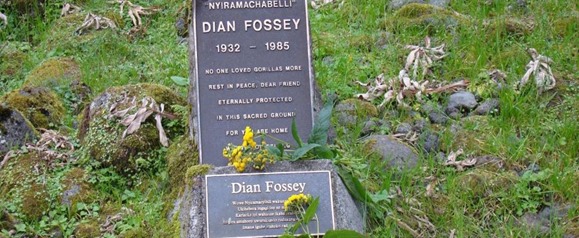
dian fossey grave post

At the site you will find the house from where Dian Fossey was mysteriously murdered in 1985 but the more peaceful is the place where she was buried just next to her favourite gorilla, Digit and about 20 other mountain gorillas either killed by poachers or suffered death for other reasons.

The tomb’s headstone reads:

No one loved gorillas more

Rest in peace, dear friend

Eternally protected

In this sacred ground

For you are home

Where you belong

In her journal, Dian Fossey’s final words were, “When you realize the value of all life, you dwell less on what is past and concentrate more on the preservation of the future.”

Today, Dian Fossey Gorilla Fund monitors ten gorilla groups (out of 15 total) in Rwanda and have so many other projects to help conserve the gorillas and other animals in the region.

This hike is an incredible experience physically, emotionally and intellectually. It is so inspiring to learn about someone who was so dedicated and left a legacy that exists even today. If you find yourself in Rwanda and you’re up for a challenge, I highly recommend the hike.

The Park fee for this Karisoke Trek is currently USD$ 75 per person, which includes the fee for the guide. The trek starts at 07:00am from the Park Headquarters in Kinigi, from where visitors will have to drive / be driven to the start point for the trek. Permits can be purchased on the day of the trek at the Park headquarters and porters can be hired from here.