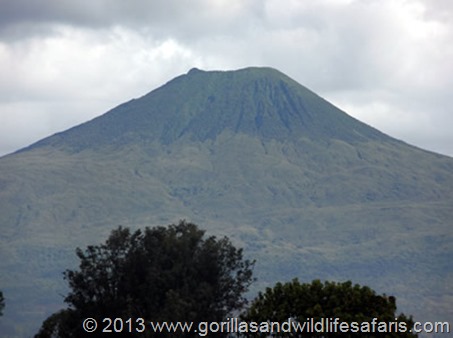
Climbing Mount Karisimbi (Rwanda)

Mount Karisimbi is the highest of the eight volcanoes in the Virunga Mountains. It is a huge dome, now dormant, that dominates the range, more in girth than in height. Its name in Kinyaruanda means white shell, which refers to its often white-capped summit. Interestingly, this cap results not from snow but from hail and sleet which accumulate in the higher elevations from its frequent storms. It is located within the Parc National Des Volcans, and many of the volcanoes are connected by good trails.

The going is quite steep and good navigation is required not only through the lower slopes, but also on the mountain itself. It consists of secondary jungle and in the most gives an aerie appearance. It is close the the jungle HQ of Dianne Fossey the renowned gorrila expert.

The ascent of Karisimbi (at 4,507m the sixth-highest mountain in Africa, after Kilimanjaro, Mount Kenya, Ruwenzori, Mount Meru (Tanzania) and Ras Dashen in Ethiopia’s Simien Mountains) is a two-day excursion; ORTPN will provide guides but trekkers should have suitable clothing and equipment. This activity needs to be arranged at least 2 days in advance. Cost is $400 and includes the guide but you may need to pay an extra $10 for tent hire.

The drive from the park office to the trailhead is 16 km and takes about 30 minutes to the car park where the road ends. Here you shall meet your porters (who you hire at Rfr5,000 per day and this’ not included in the cost). The climbing starts from about 2,600m ASL.

At about 2,067m ASL, you reach close to the Dian Fossey tomb and gorilla graveyards (but visiting would require you pay an extra fee). Your will then traverse different vegetation zones: bamboo and wild celery on the lower slopes, ideal food for gorillas. Then hagenia forest, with old man’s beard moss on the branches. Then above 3,000m, the marvelous giand groundsel and giant lobelia. Your first camp is at 3,700, a similar altitude to Bisoke, clearly visible behind the camp.

The next day you wake as early as 5:30AM for your breakfast and early departure. The trail gets steeper, much as the fog closes in and ground gets muddy. The terrain gets more tougher here. At about 4,000m, you are above the tree line, the slopes become more exposed and here you need to wear your gloves and hat. After about 2 hours ascent, you start on you last hundreds meters of climbing, walking on volcanic scree (more like grey gravel but not loose). The wind starts getting harder and visibility drops to 25m. Suddenly, you realize you cannot climb the anymore – you are at the summit! The Congolese border is just within a few feet from here. The descent back to the car park takes about 6 hours (including breaks at the camp and the others).

Other Vital Facts:

Best months for climbing :    Jan, Feb, Mar, Jul, Aug, Sep, Oct
Volcanic status:   Dormant
Year first climbed: 1903
Latitude: -1.5
Longitude: 29.45
Difficulty: Scramble
Elevation (feet): 14787
Elevation (meters): 4507
My mountain Uganda gorilla tracking experience in Bwindi’s Oruzogo gorilla family

Tracking Gorillas in Bwindi’s Oruzogo Gorilla Family

Gorilla Trekking remains one of the most magical and rewarding wildlife experiences in the natural world, one that I know is high on the wish list of Uganda’s tourists. An estimated 880 mountain gorillas are remaining on earth, approximately 480 of which reside in Bwindi National Park.

Some background information abour Oruzogo Gorilla Family

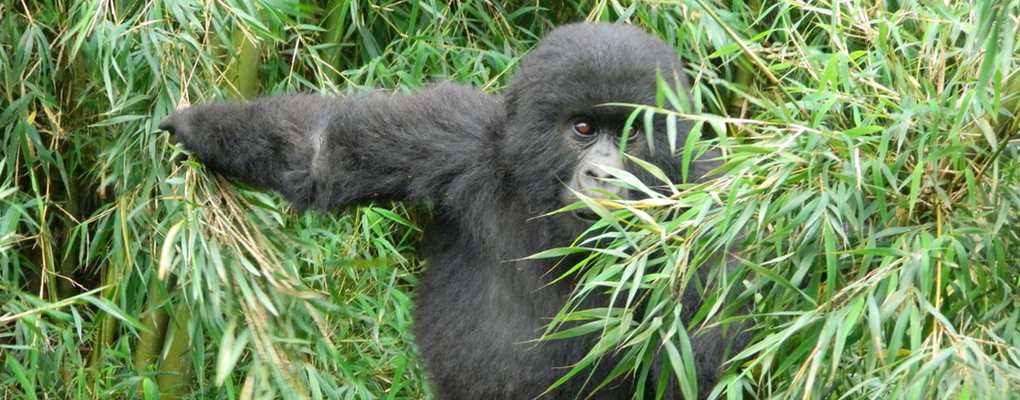
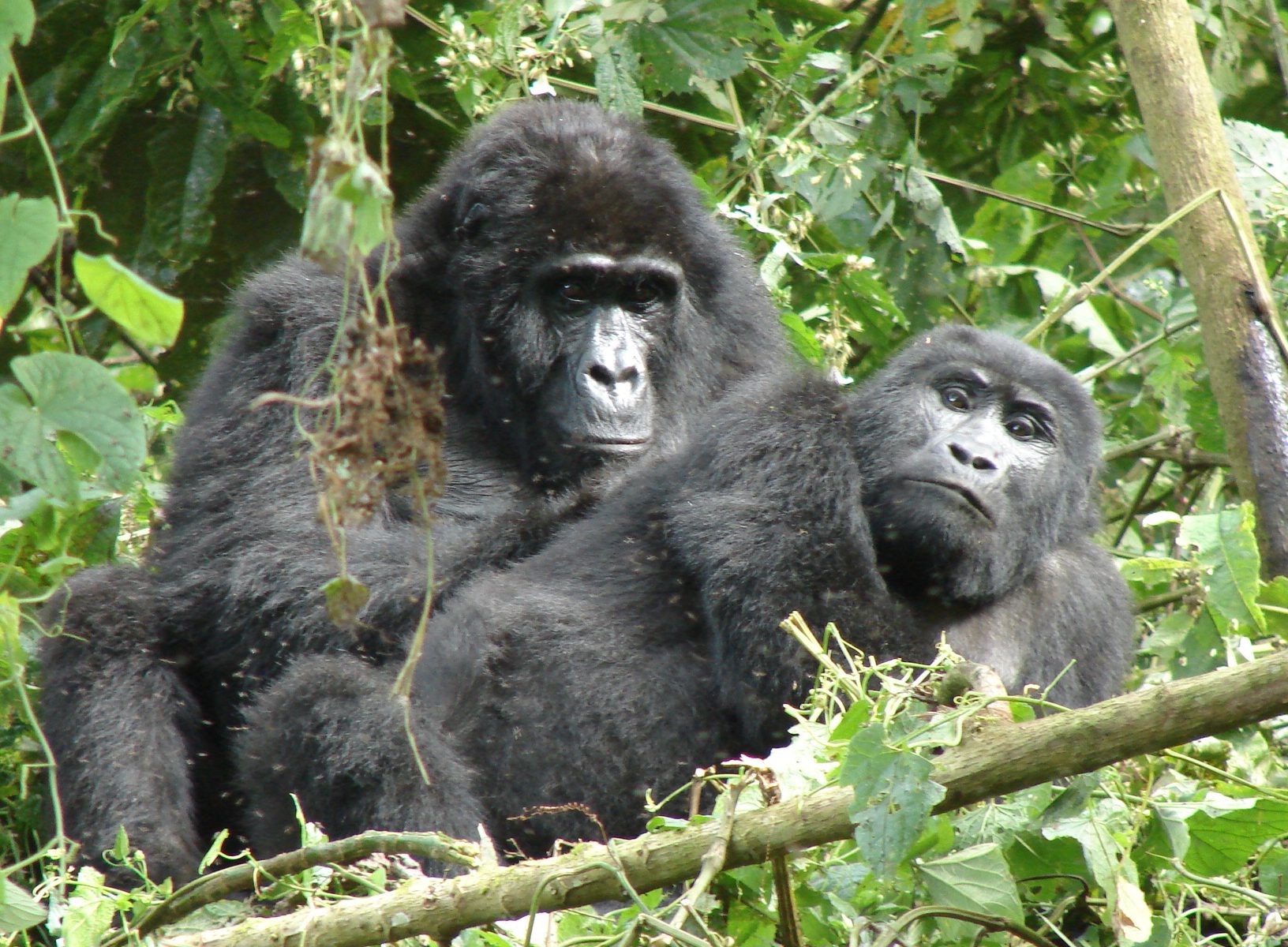
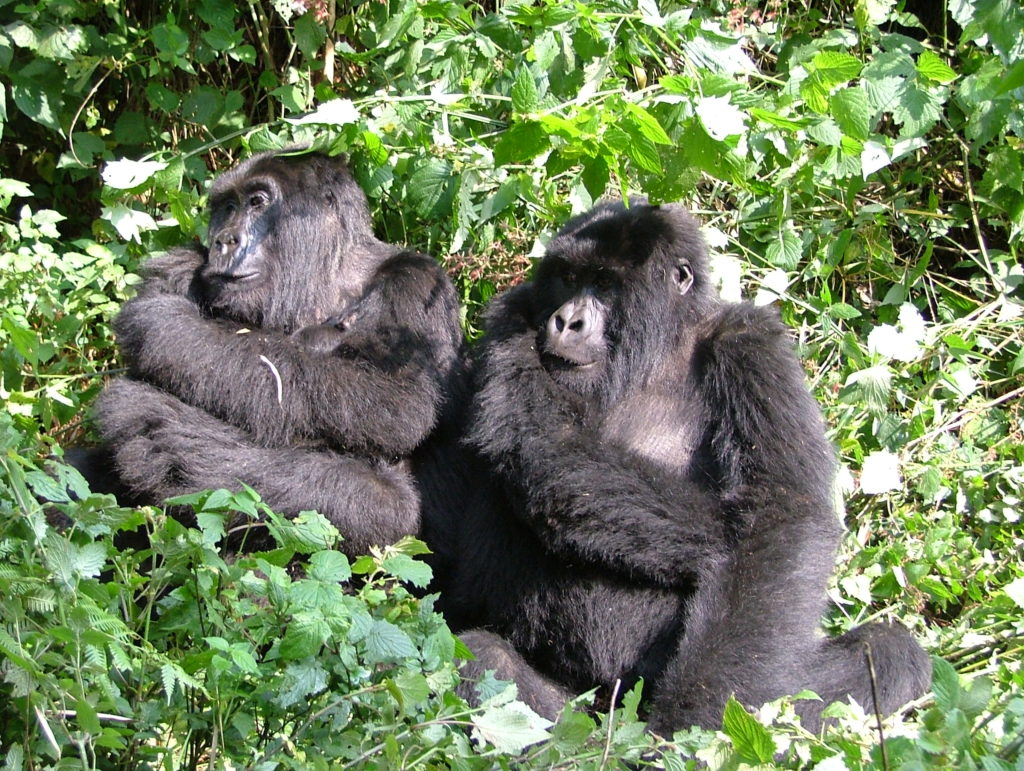
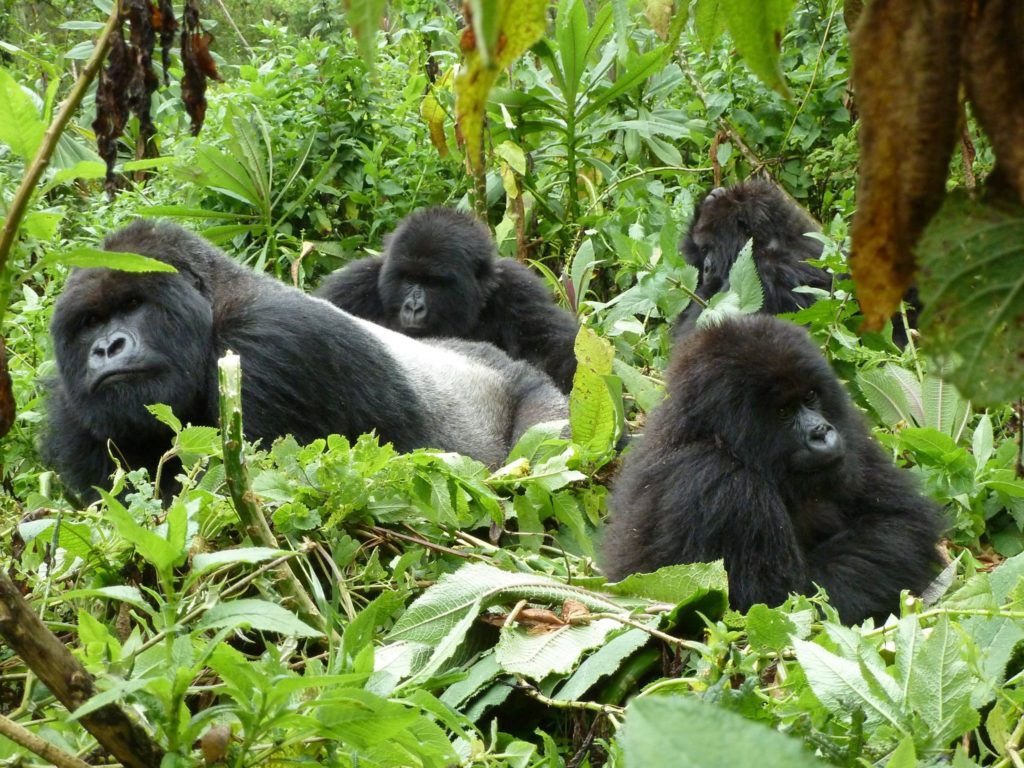
Oruzogo mountain gorilla in Bwindi Impenetrable National Park, Uganda

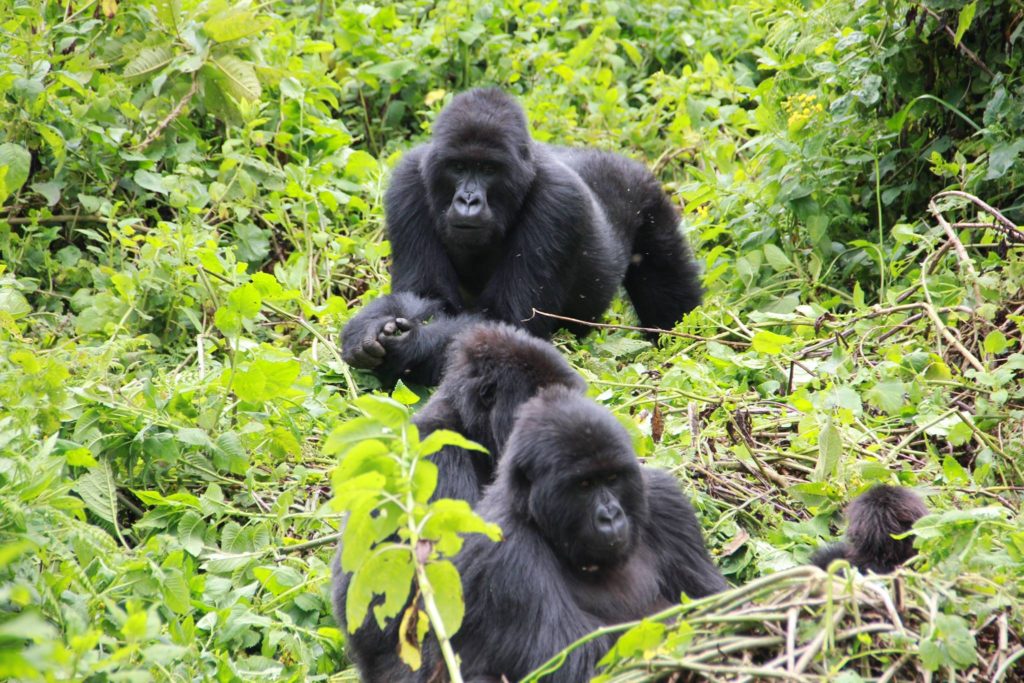
Oruzogo gorilla group is located in Ruhija together with Bitukura,and Kyaguriro (which is the gorilla family dedicated purely for research). This gorilla family can be trekked from Buhoma or Ruhija. The group consists of 16 individuals including 1 dominant silverback (named Tibirikwata)  and two babies that were recently born.  Although the sex of the two babies is yet to be established, the proud mothers are the cute adult females Birungi and Mutesi.  The new babies join the posse of other infants Buchura and Kanywani who is Kakobe’s baby.
Naming all the 16 individuals save for the three infants who are currently known by their mothers’ identities like Mutesi baby or Birungi baby was completed before it was availed for tracking in 2012.
Other individuals in the group include Busungu(Meaning short tampered),Kashundwe, Nyakiina,Kaganga (the giant one),Otaka,Bwoba(the coward) Karimi (tongue) Kiromba, KLatooto (the small one)Kanywani(meaning friendly,Kakobe who looks like a monkey and Buchura referring to the youngest or last born before the two newest babies came forth.

My unforgettable experience tracking these gentle giants

I had a unique opportunity to join a UWA team visiting the newly habituated Oruzogo gorilla family.
On my big day, I was up at 6:30AM to join the UWA team into the forest. Bwindi is nicknamed the ‘impenetrable forest’, and I’ve got to say that it’s easy to see why; at times it was literally impossible to make your way through the vegetation, even with the trackers carving a path for us with their machetes.

Black-and-white colobus monkeys,
one of the 10 primate species in Bwindi –

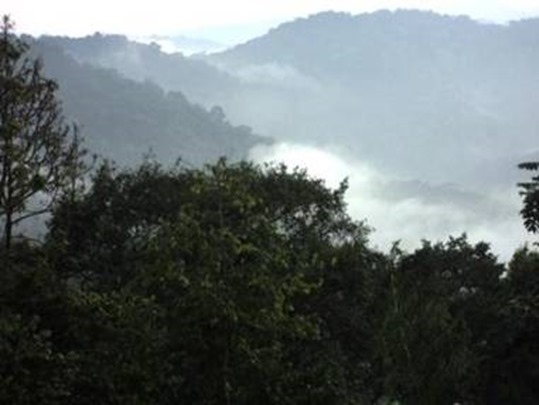
Heavy rains, and dying plants nourish this dense forest, but the benign gentleness of the morning and gently stirring grass and vines along the trails cunningly hide the never-ending dramas of the impenetrable forest. In this very small forest (330sqkm) over 350 bird species occur, as well as 120 mammal species (including 10 primates) and a staggering 1000 different plant species.
Occasionally we’d tromp through an ant colony; they’d march right up my shoes and socks, under my trousers, and make their way up to my boxer shorts before biting.

After about three hours of pushing through this thick vegetation on steep terrain, we still seemed to be nowhere near any gorillas. But finally we came to a flat, open area in the jungle, about 5m in diameter. “This is where the gorillas slept last night,” the tracker told us. We all studied the area with a new interest and excitement. I noticed eight distinct impressions in the leaves – nests made by massive creatures.

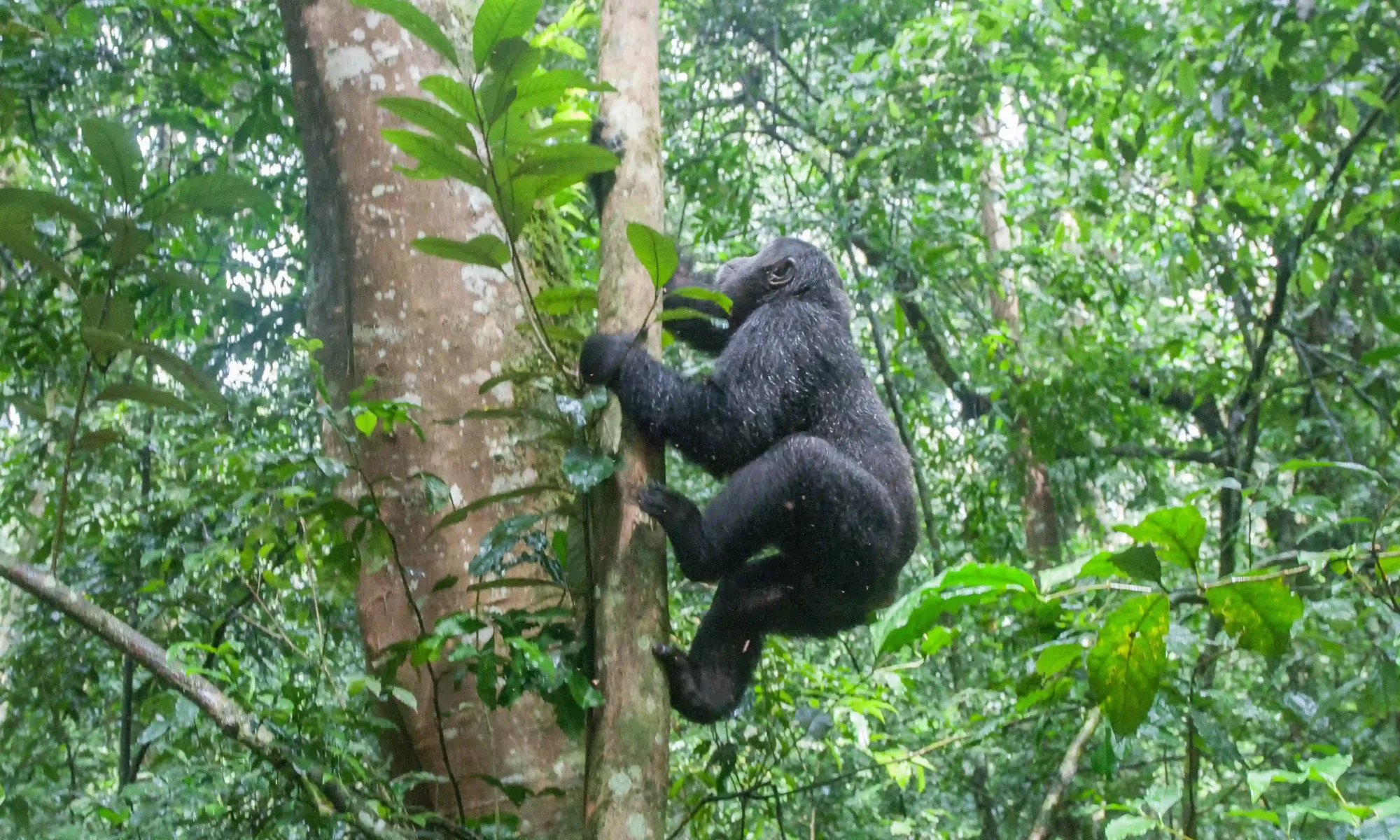
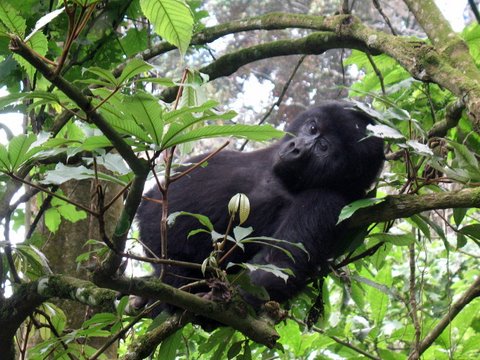
A mountain gorilla resting in trees of Bwindi
– www.gorillasandwildlifesafaris.com

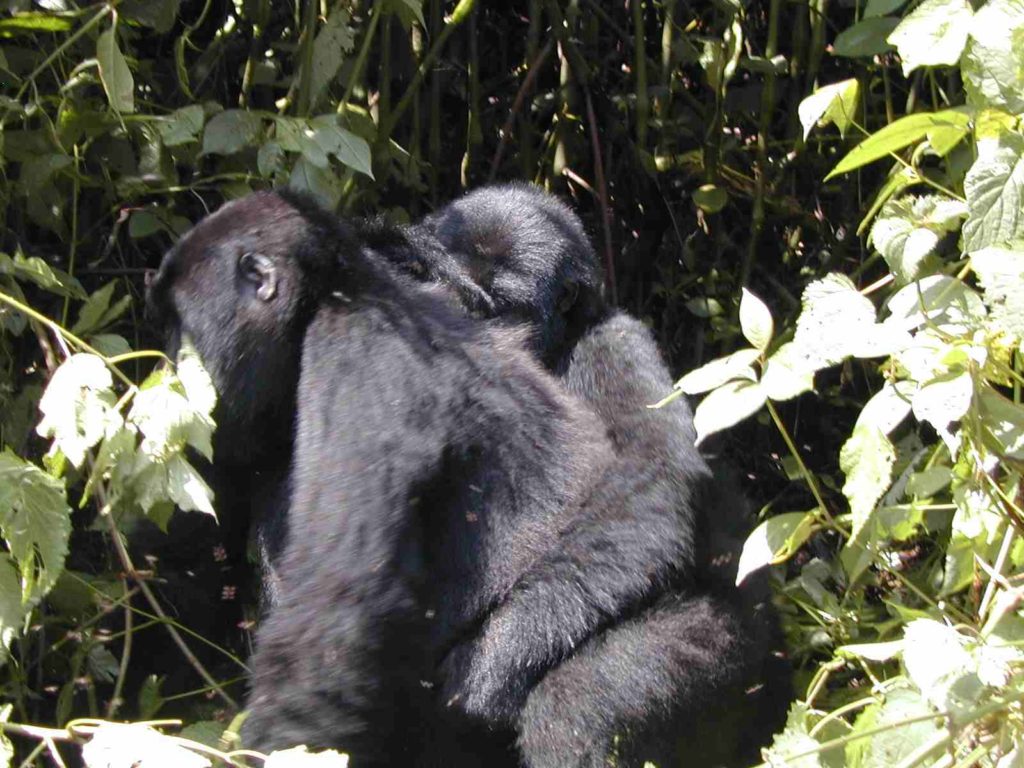
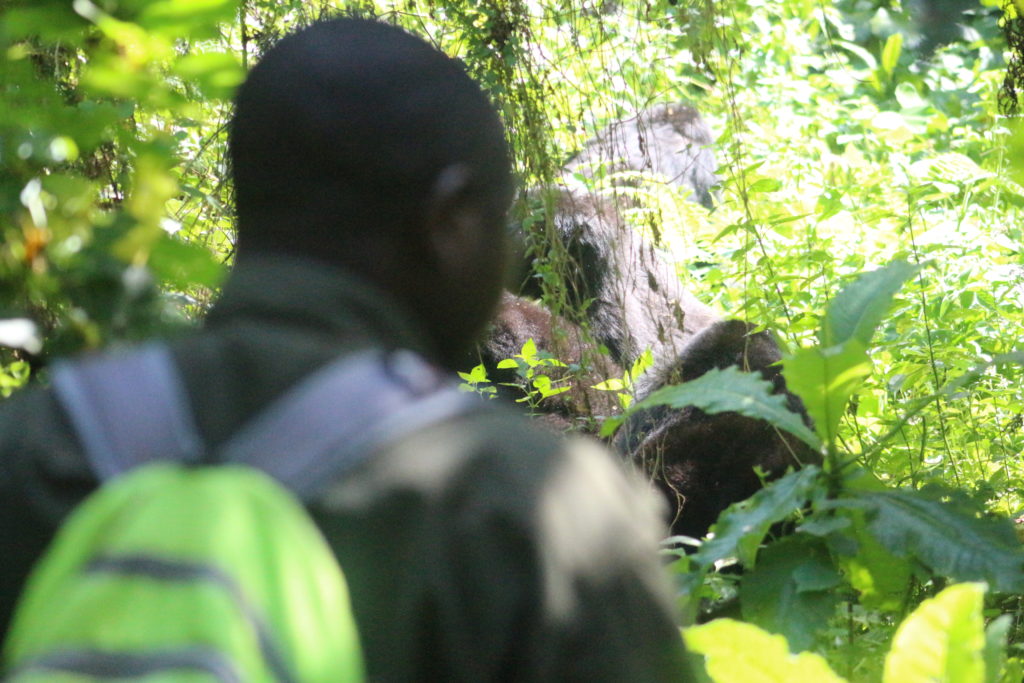
 Then we came into a slight opening, suddenly I heard branches to my immediate right snap as if a tree was falling, and a very big rumbling noise beyond anything I had ever experienced! And then there was this smell, like a pungent body odor worse than that of a human who hasn’t bathed in a month. It was then whispered that we were among the gorillas. I strained my eyes towards the shaking shrub as I held firmly onto my walking stick. There was nothing to see but the “raspberry bushes” in the gloom. Another glimpse, and then appeared a couple of square inches of black fur. It looked like being a big deal! This was it! Gradually things improved. We got a glimpse of a female with a baby balanced on her back. Finally we got ourselves near the silverback seated immersed in bushes pluck-eating branches of berries. Suddenly our luck dramatically changed, the silverback started moving further away, ignorantly exposing himself the more.

The mountain gorilla – such a deserving name for this huge giant! In my whole life, I’d never seen this legendary species! Oh. This was a lifetime experience. No matter how much you watch mountain gorillas on television or even try hard to imagine what meeting them might actually be like, nothing can quite prepare you for this 1-on-1 encounter.

Then, all too soon, we were told it was time up (an hour being the limit for gorilla visits). We withdrew to make our way back. I was pretty content with what I’d seen.

Taken as a day it ranked strenuous, but one of those that make being born and living seem fully worthwhile.

Have you been to tracking the gorillas? What’s your experience?
Are you planning to track the mountain gorillas and need assistance from a local tour operator based in Uganda and Rwanda? Please contact us or see some suggested packages below for a fast and efficient service.

Rwanda Gorilla tracking permit price raised to USD1500

The Rwanda Development Board has announced an increase in the price of Gorilla Permits from US$ 750 to US $1,500 for all visitors effective immediately.  However, the mountain gorilla tracking permit cost remains the same in Uganda at USD600 and Congo (DRC).

According to RDB, the new price increase will not affect tourists who had already purchased their tickets at the time of this announcement.

A new exclusive package for tourists who wish to book an entire family of gorillas was also introduced at US$ 15,000, and will receive exclusive personalized tour guide services.

The price increase will not affect tourists who had already purchased their tickets at the time of this announcement.

Clare Akamanzi, the Chief Executive Officer at Rwanda Development Board said: “Gorilla trekking is a highly unique experience. We have raised the price of permits in order to ensure sustainability of conservation initiatives and enhance visitors’ experience. We also want to make sure that the communities living near the park area receive a bigger share of tourism revenues to fund development projects and empower them economically.”

Meanwhile, tourists who visit other national parks; Nyungwe National  Park and Akagera National Park for a minimum of three days, in addition to gorilla trekking will receive a discount of 30%.

Similarly, conference tourists, who stay pre or post conference dates to see gorillas will be eligible for a 15% discount.

The price increase aims to strengthen conservation efforts and contribute more to the development of communities living around the Volcanoes National Park, RDB said in a communiqué.

According to RDB, tourism revenue sharing rate for communities adjacent to the park will also increase from current 5% to 10%, which will increase absolute revenues received by communities.

Over the last 12 years, more than 400 community projects have been completed including hospitals, schools, business development centers and water supply systems to facilitate access to clean water.

Mountain gorillas are an endangered species with only around 880 remaining in the world. Of these, about 400 live in the Virunga Massif  striding across Rwanda, Uganda and the D.R.Congo, while at leas 448 mountain gorillas live in Uganda’s Bwindi Impenetrable National Park.

Rwanda gorilla permit will cost 1500 USD

The Rwanda Development Board today announced an increase in the price of Gorilla Permits from US$ 750 to US $1,500 for all visitors effective immediately. A new exclusive package for tourists who wish to book an entire family of gorillas was also introduced at US$ 15,000, and will receive exclusive personalized tour guide services.

The price increase will not affect tourists who had already purchased their tickets at the time of this announcement.

Tourists who visit other national parks (Nyungwe and Akagera) for a minimum of three days, in addition to gorilla trekking will receive a discount of 30%. Similarly, conference tourists, who stay pre or post conference dates to see gorillas will be eligible for a 15% discount.

In line with Rwanda’s high-end tourism strategy, the price increase aims to strengthen conservation efforts and contribute more to the development of communities living around the Volcanoes National Park.

Along with the new tariff, the tourism revenue sharing rate for communities adjacent to the park, will also increase from 5% to 10%, which will quadruple the absolute revenues received by communities. Over the last 12 years, more than 400 community projects have been completed including hospitals, schools, business development centers and water supply systems to facilitate access to clean water. These projects directly benefit the people living around the parks.

Ms. Clare Akamanzi, the Chief Executive Officer at Rwanda Development Board said:

“Gorilla trekking is a highly unique experience. We have raised the price of permits in order to ensure sustainability of conservation initiatives and enhance visitors’ experience. We also want to make sure that the communities living near the park area receive a bigger share of tourism revenues to fund development projects and empower them economically.”

New, high-end lodges are opening in Musanze and plans are underway to improve visitors’ experience at Kinigi, including renovation of the information center to equip it with modern offices and tourism services such as conservation education, children’s learning space as well as digital facilities.

Mountain gorillas are an endangered species with only around 880 remaining in the world. Of those in in the Virunga Massif, Rwanda accounts for 62% of the gorilla population. Stringent conservation measures have significantly contributed to a rise in gorilla numbers. There are currently 20 families habituated for tourism and research in Rwanda, up from just 9 families in 2010.

Where to find Mountain Gorillas

There are approximately 900 mountain gorillas remaining on earth. Unlike other gorilla species, mountain gorillas cannot live in captivity. They only survive in their natural habitat, afro-montane forests only found in Uganda, Congo (DRC) and Rwanda. These are located in the Virunga mountains (striding across the three countries) and Uganda’s Bwindi Impenetrable National Park. The Virungas contain Uganda’s Mgahinga Gorilla National Park,  Rwanda’s Volcanoes National Park and Virunga National Park in DRC. Bwindi Impenetrable NP has about 60% of the earth’s mountain gorillas.

Mountain gorillas live in families similar to humans, with a dominant silverback male. Humans can access these endagered giants after they have gone through a program called habituation which takes at least 2 years. About 28 gorilla families have been habituated for research and tourism. Tourists can visit the gorillas through an activity called gorilla tracking or trekking. It is called gorilla tracking because you walk in the tracks of the mountain gorillas as you search for them through the forests. It is also called trekking because you trek through forested highlands to find the gorillas. Basically you follow to where the gorillas spent the previous night to find them that day.

Your would need a gorilla tracking permit to track the mountain gorillas.  Each gorilla permit is USD600 in Uganda; USD1500 in Rwanda, $400 in DRC. This entitles you to 1 hour in the presence of mountain gorillas. You can however pay USD1500 for a gorillas habituation experience and get four hours with the gorillas in Uganda’s Bwindi.

On each given day, a gorilla family can be visited by a maximum of 8 persons. Chances of sighting the gorillas are real hight but of course there is no 100% guarantee for wildlife in its natural home.

All about the life and ecology of mountain gorillas

Uganda Rwanda gorilla safari wildlife chimpanzee combination

The endangered mountain gorilla is one of the subspecies of the gorilla. The other subspecies is the lowland gorillas, it is a specie most often found in zoos.

There are approximately 900 mountain gorillas remaining on earth. Unlike other gorilla species, mountain gorillas cannot live in captivity. They only survive in their natural habitat, afro-montane forests only found in Uganda, Congo (DRC) and Rwanda. These are located in the Virunga mountains (striding across the three countries) and Uganda’s Bwindi Impenetrable National Park. The Virungas contain Uganda’s Mgahinga Gorilla National Park,  Rwanda’s Volcanoes National Park and Virunga National Park in DRC. Bwindi Impenetrable NP has about 60% of the earth’s mountain gorillas.

Mountain gorillas live in families similar to humans, with a dominant silverback male. Humans can access these endagered giants after they have gone through a program called habituation which takes at least 2 years. About 28 gorilla families have been habituated for research and tourism. Tourists can visit the gorillas through an activity called gorilla tracking or trekking. It is called gorilla tracking because you walk in the tracks of the mountain gorillas as you search for them through the forests. It is also called trekking because you trek through forested highlands to find the gorillas. Basically you follow to where the gorillas spent the previous night to find them that day.

Mountain gorilla sub-speceis names are given based on their habitat location: lowland gorillas live in montane forests while mountain gorillas live at high elevations of up to 10,000 feet on the slopes of volcanoes. The lowland gorillas can be found on lowland forests and prefer living in thick rain forests of Central Africa in countries of Cameroon, Equatorial Guinea, Angola, Gabon, Central African Republic and in the Democratic Republic of Congo in Odzal-kokoau National Park (one of the oldest national park in Africa covered by 1,360million hectares of pristine rainforest).

In description, the male mountain gorillas are usually twice the size of the female, they can be 6 foot tall and weigh 350-500 pounds. They are simply strong with muscular long arms. The males are called silverback because their hair on the back gets a silver color as they mature. The males’ strength is 10 times stronger and its arms stretch out long. The mountain gorillas have longer and darker hair since they live in colder climate at much higher altitude compared the lowland gorillas that tend to be smaller and have brownish-grey coats and a pronounced brown ridge. The mountain gorillas have a life span of 40 to 50 years of age.

Mountain gorillas are herbivores, feeding on plants like wild celery, thistle, and nettles about 150 various plants. Special trees are bamboo and bracket fungus. Their food plants grow profusely in the cool, moist mountain climate of their range in Rwanda, Congo and Uganda During the rainy season because the bamboos are tender and green, the bamboo shoots contain 84% of water with an extra of trocatea, flowers, stems, roots, soft bamboo leaves as well as the dry season black berries that act as a delicacy for the mountain gorillas.

There is more movement if there is scarcity of food, it may be hard to easily spot the gorillas. Again during the rainy season, the mountain gorillas are dormant with less activity to do. The gorillas move from one place to another looking for food, sometimes plants and trees change with the weather. Adult mountain gorillas feed on about 60 pounds of vegetation daily.

While it is true that they are large, powerful and very strong creatures, mountain gorillas are also affectionate, gentle, shy and easygoing creatures that live a peaceful and playful life. They live in groups that can vary in 2 to 30 to 40 but most are in groups of around 10. There is no mating season and babies are born all year long. Males start breeding at about 15years and females give birth from 10 to 12 years old. They give birth every 2 to 3 years giving 4 to 6 off springs during lifespan.

Large males patiently allow young gorillas to climb all over them without a murmur of protest, about 11yeras of age, the males leave their group. They communicate by sounds such as grunts, shouts and roars, 25 sounds have been recognized by researchers. Since the gorillas share a lot with humans, you will be surprised by the way the mother gorillas look after its younger one, their relationship and close bond created usually lasts for about 4 years. After the four years, the female can conceive again.

A mother gorilla is acknowledged to have close to six babies with a time frame of four years. When the gorillas get to their sexual maturity, they want to move out of the group and form a new one as they mate with others. Mountain gorillas are habituated that is they are accustomed to people a process that takes about 2 years. They are not aggressive towards humans unless they are threatened.

How to book gorilla trek tour in Uganda, Rwanda and Congo

How to book a gorilla trek tour in Uganda, Rwanda and Congo

  1. Choose your gorilla trekking or gorilla tracking destinationMountain gorillas can only be found in Uganda’s Bwindi Impenetrable National Park (60% of them) and the Virunga Massif which consists of Mgahinga Gorilla National Park (in Uganda), Volcanos National Park in Rwanda and Virunga National Park in DRC.
  2. Book your gorilla permitTo track or trek the gorillas, you need a pre-booked gorilla tracking permit. Currently, a gorilla permit costs USD600 in Uganda, $1500 in Rwanda and $400 in DRC. A gorilla permit entitles you to one day of gorilla tracking with about 1 hour in the presence of the gorillas. It also includes the park entrance fee for the day and the park guides for the trek.To be safe, you need to book your gorilla tracking permit at least three months in advance. For busier months of July to September and January to March, you permit should be booked at least seven months in advance as most places sell out as you get closer.Since all national parks with mountain gorillas are located remotely away from the cities you arrive at, in addition to the gorilla permit, you need to plan for your transportation to the parks, accommodation in the parks, and your meals. A gorilla tracking trip can for at least two days in Rwanda, and three days in Uganda and DRC. Because of the complexities involved in arranging all this, many involve services of local tour agents to plan and execute the gorilla tracking tours.Several companies provide permit bookings for gorilla trekking and gorilla habituation experience.  While booking a gorilla tour, always pay your gorilla permit fee in advance to enable companies acquire it for you. Gorilla trekking is only guaranteed when you acquire a permit.
  3. Book Accommodation during your gorilla trek tour and transportation

After paying for your gorilla tracking permit, you are now fine to go ahead with the rest of your tour bookings like accommodation, transportation, air tickets among others.

For Rwanda gorilla tracking tours, transportation can only be by road- either by public means or by private hired tour cars, but you will anyhow need to arrange private means from Musanze town to the park and back, and also to the gorilla trek start point. It takes about 2 hrs from Kigali to Volcanoes NP.

For Uganda, you could do with public buses up to a town near the park and then hire taxis to the park. Several tour agents hire transportation from the capital Kampala to the park. It takes about 8 hours driving. Daily flights are also available between Bwindi and Entebbe but you would still need to arrange transfers from the airports to the park/ accommodation.

There’s plenty of accommodation facilities near all gorilla parks and they are quite easy to book in advance.

Comparing Uganda and Gorilla Trekking Experience

Okay, aside from the price differences with the Rwanda gorilla tracking permit now at $1500 and Uganda gorilla going for $600 (and $450 in November, April and May), could there be some real difference in the experience one finally gets?

As all the mountain gorillas in both countries are the same species only separated by national boundaries, the only difference that should mainly arise is in your experience in the tracking and the general gorilla tour arrangement.

Because Rwanda’s Volcanoes National Park is only about 125kms from your arrival airport – Kigali, it makes much easier to access by road. For Uganda’s Bwindi/ Mgahinga, you would need 8 hours to drive from Entebbe Airport and another 8 hours back to the airport, although daily flights are available (taking about 50 minutes).

With this prevailing, you would need at least two days to complete your gorilla tour in Rwanda and 3 days for a Uganda gorilla tour.

So, even though the Uganda gorillas permit are cheaper, you would incur a transport cost of about $500-$600. Some visitors choose to arrive in Kigali and arrange to visit Bwindi from Kigali. You would still need 3 days for the entire tour.

A Case for the long drive to Uganda’s  Mountain Gorillas:

As you drive the 8 hours to Bwindi Impenetrable National Park,  the scenery is really amazing. Besides the usual stops – at the Equator, you get to see fantastic views of the region fames as “the Switzerland of Africa”, Lake Bunyonyi. The traditional village setting along the way is another thing to behold.
On any drive, you are sure to traverse at least one other  national park (either Kibale or Queen Elizabeth National Park famous for tree climbing lions and many other big mammals, or Lake Mburo National Park) sighting a number of animals along the way like lions, elephant, zebra, antelopes among others.

You also have wider opportunities for extending your tour for greater exciting experiences in other protected areas in Uganda which is not necessarily the case for Rwanda. Although even in Rwanda you can visit the Akagera National Park (now with rhinos, giraffes and lions), Nyungwe NP for more primates and relax at Lake Kivu, this won’t tally at all with the opportunities offered by the 10 national parks of Uganda.

The gorilla trek experience:

Many have argued that the terrain in Uganda is rather rough and it is smoother in Rwanda. No, this is not true in any sense. The terrain is both rough and smoother in either countries. It is the location of particular gorilla families that determines how tough or smooth your gorilla trek will get. Many of the gorilla families located in the north of Bwindi offer very little challenge to track. Yet families in Bwindi’s Nkuringo and Rushaga sectors are located on/ along ridges which offers a good challenge in tracking them.
In Volcanoes National Park, there are gorillas families that offer little challenge to tracking while for families like Susa, you might spend the entire day tracking.

Many have also argued about the thick undergrowth in either parks. Some sections of Bwindi can really be thicker making photography a challenge. But when you finally locate the gorillas, they mostly be in open places and photographs can easily be taken. Volcanoes NP is not much different except that the way to the gorillas has less undergrowth making photography (along) much easier.

Every other day when starting the gorilla trek, Volcanoes National Park will have a traditional cultural dance troupe perform for the trekkers which is not so in Bwindi. Instead you get to watch a short film about gorilla conservation and the usual briefing in Bwindi before the trek.

Why then the difference in the Gorilla Permit price?

In proposing the $1500 for a gorilla permit,  Rwanda Development Board asserted that they wanted to offer more community support for park neighbors. They also intend to raise more funds for supporting conservation of the mountain gorilla. We also observe that Rwanda has a tarmac road leading up to the Volcanoes National Park headquarters and it takes not more than 2 hours to reach the park from Kigali International Airport.

We also observe that in all honesty, the gorillas are the best you can get from Rwanda. Experiences from the other attractions really offer no serious competition to similar offers from the regional neighbors. Many tourist indeed only fly into Rwanda for the gorillas and then do the other days in Uganda, Kenya and or Tanzania. Some even land in the wee hours of the morning, track the gorillas and fly out in the evening on the same day to a neighboring country for a week or more for more touring. Aside from the gorilla tracking permit fee and transport to the park, Rwanda would not be reaping much from such one-day tourists who only spend on gorillas. With the $1500 at hand, Rwanda will now still earn a bare minimum regardless of how long you spend and if you chose to visit their other parks, well and good; they will even give you a discount for that!

Uganda has assured the industry that they will not change the gorilla permit fee for at least 1 year. They are certainly sure that even with the low permit price, a tourist can spend more nights in Bwindi are doing other activities and there is more chances of a tourist visiting the other 9 national parks and spending more there.
To many, driving along Rwanda’s paved eucalyptus avenues to the gorillas in not the best deal. Indeed many to purchase tour packages combining both Rwanda and Uganda, first doing Gorillas in Rwanda and then crossing to Uganda to visit Queen Elizabeth National Park for the BIG 5 safaris and chimpanzee tracking among other tours.

Maybe you could have a different reason for preferring gorilla trekking in one country over the other. Please let us know so that we all make more informed choices in our planning.

Why the Gorilla Permit Price difference between Rwanda and Uganda ?

They are the same mountain gorillas species, only separated by national boundaries, yet the price for a gorilla tracking permit is $1500 in Rwanda, $600 for Uganda ($700 starting July 2020). What could be the reason for the difference?

In proposing the $1500 from $750 for a gorilla permit,  Rwanda Development Board asserted that they wanted to offer more community support for park neighboring communities. They also intend to raise more funds for supporting conservation of the mountain gorilla. Uganda on the other hand stayed the gorilla permit price for at least one year even though they also have a local community support percentage off the every permit sold.

In all honesty, the gorillas are the best you can get from Rwanda. Experiences from the other Rwanda tourist attractions really offer no serious competition to similar offers from the regional neighbors. Many tourist indeed only fly into Rwanda for the gorillas and then do the other days in Uganda, Kenya and or Tanzania. Some tourists even land in the wee hours of the morning, track the gorillas and fly out in the evening on the same day to a neighboring country for a week or more for more touring. Aside from the gorilla tracking permit fee and transport to the park, Rwanda would not be reaping much from such one-day tourists who only spend on gorillas. With the $1500 at hand, Rwanda will now still earn a bare minimum regardless of how long you spend and if you chose to visit their other parks, well and good; they will even give you a discount for that!

Uganda has assured the industry that they will not change the gorilla permit fee for at least 1 year. They are certainly sure that even with the low permit price, a tourist can spend more nights in Bwindi are doing other activities and there is more chances of a tourist visiting the other 9 national parks and spending more there.
To many, driving along Rwanda’s paved eucalyptus avenues to the gorillas in not the best deal. Indeed many to purchase tour packages combining both Rwanda and Uganda, first doing Gorillas in Rwanda and then crossing to Uganda to visit Queen Elizabeth National Park for the BIG 5 safaris and chimpanzee tracking among other tours.

Maybe you could have a different reason for preferring gorilla trekking in one country over the other. Please let us know so that we all make more informed choices in our planning.

Mountain Gorilla Habituation Experience – Definitely better than normal!

Gorilla habituation is the process through which a gorilla family gets used to human visits. A great opportunity to spend 4 hours with the Bwindi mountain gorillas instead of the standard 1 hours for USD1500 per permit per person. The habituation experience is done Bikingi Gorilla Group of Bwindi, in Rushaga Sector. 

A gorilla habituation process takes a period of 2-3 years and it involves an advance team from the Uganda Wildlife Authority making frequent visits to the gorilla family. Upon establishing that the group is used and welcoming to tourists, the gorilla family becomes ready for tourists’ visits.

With the gorilla habituation experience, you move with researchers to experience how mountain gorillas are habituated. The price for mountain gorilla habituation experience is now at USD1500.00 and one can stay for up to four hours.

A maximum of only 4 visitors per day are being allowed to visit the gorilla habituation experience, compared to the 8 visitors on a normal Trek. One thing is certain, the Gorilla Habituation Experience is a one of a kind, exclusive activity in which only a select few can participate.  It is a learning experience, you learn from the researchers, trackers, rangers, conservationist, who are all part of the Habituation Process.

The Experiential Gorilla Habituation Experience in the Rushaga Area of Bwindi Forest is a Pilot Program that is closely monitored by Uganda Wildlife Authority.  It has been a phenomenal success judging by our clients’ responses.