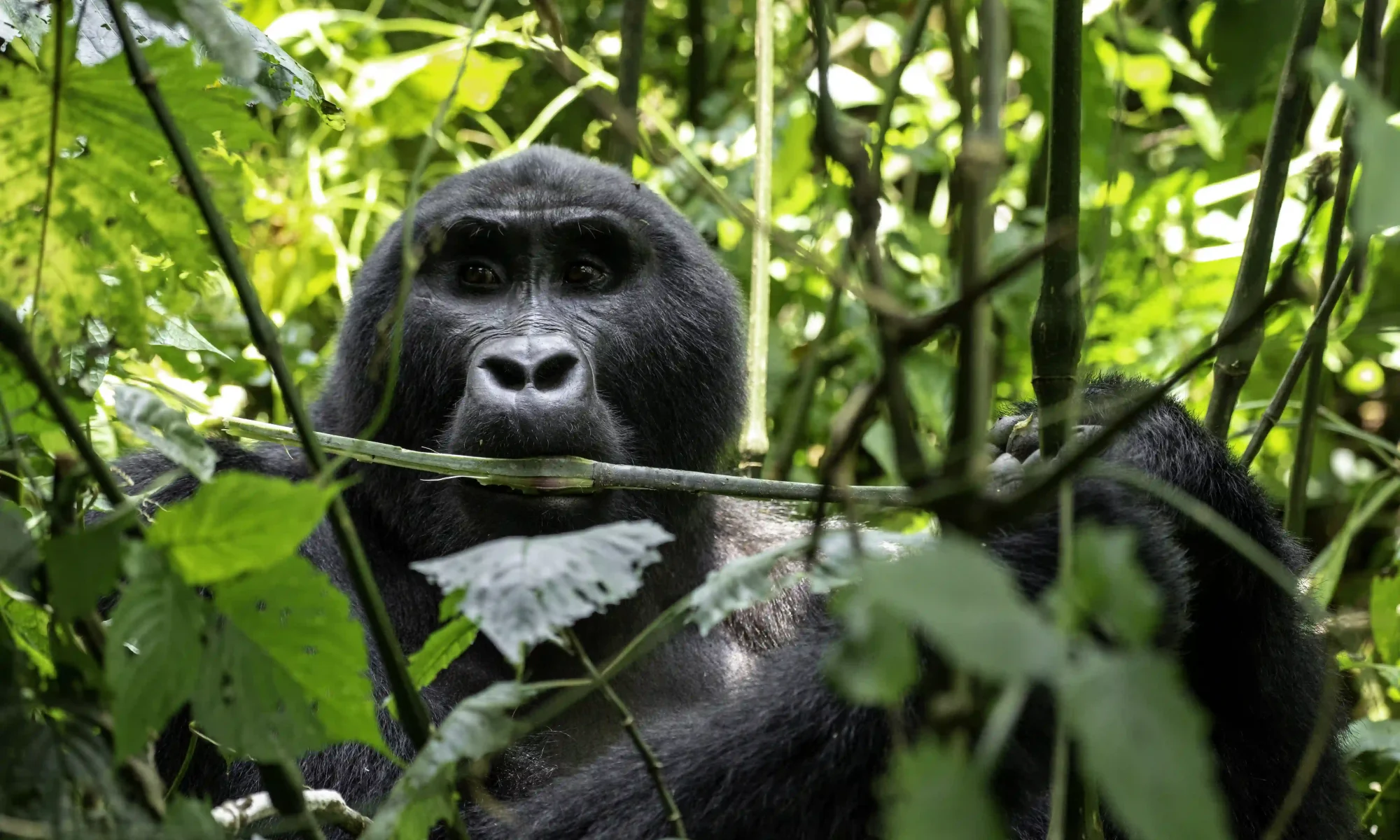
f you choose to do a gorilla trek tour in Uganda’s Bwindi, you will be allocated to track gorillas in either of the park’s 4 sectors. One of these is Nkuringo in the south of Bwindi which has 3 gorilla families or gorilla groups.
Tracking gorillas in Nkuringo sector offers some of the the most challenging gorilla treks within Bwindi Impenetrable Forest.
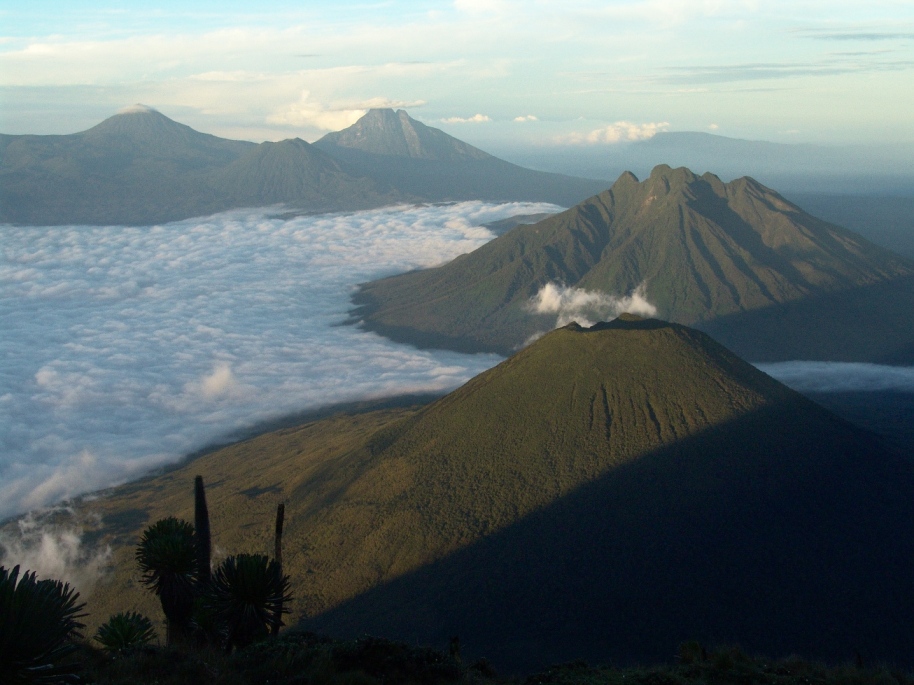
If you are a photographer – Nkuringo is a location that you do not want to miss in all of Uganda- it simply is an incredible location – and the views seem to change all day long – from the early morning mist to the sunset in the evening – Nkuringo is truly magical and mere words cannot describe its beauty and wonders – you have to visit this incredible spot in Bwindi Impenetrable Forest and you too will see it as one of the most stunning locations in all of Africa – an experience in sight, color, the surrounding sounds that weave together a tapestry of memories of this magical place called Nkuringo.
Gorilla Groups in Nkuringo Sector of Bwindi
NKURINGO GORILLA FAMILY
12 MEMBERS
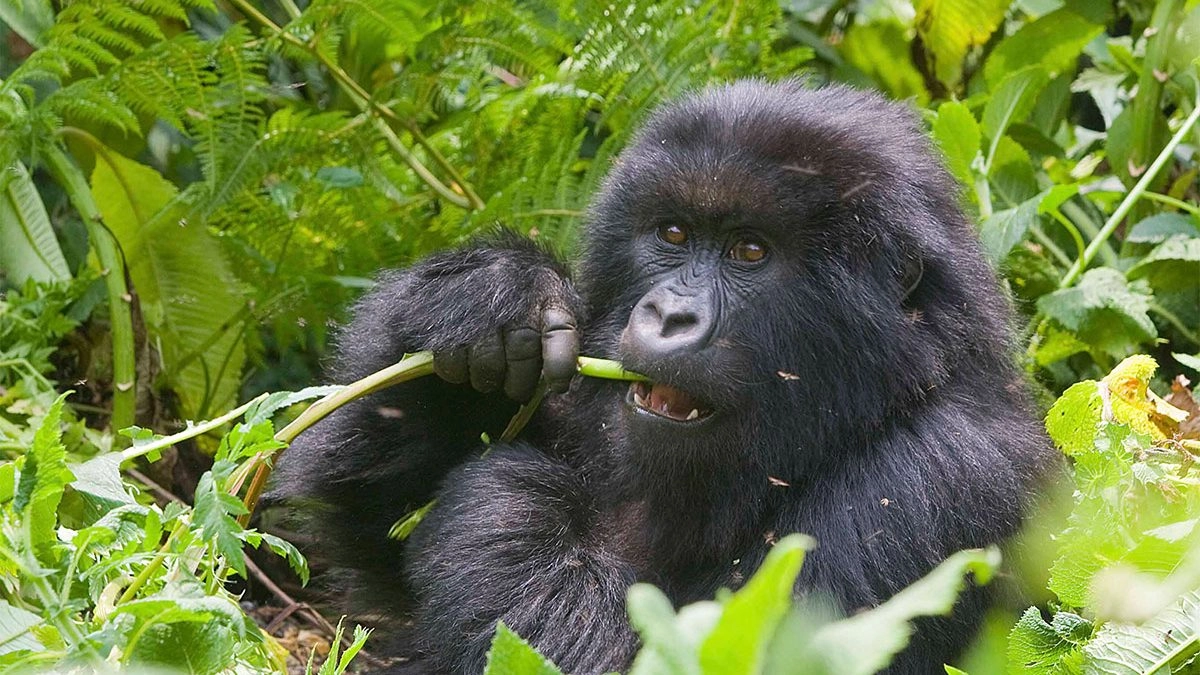
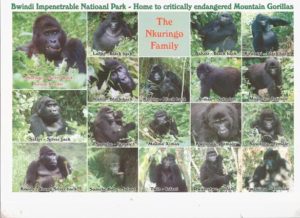
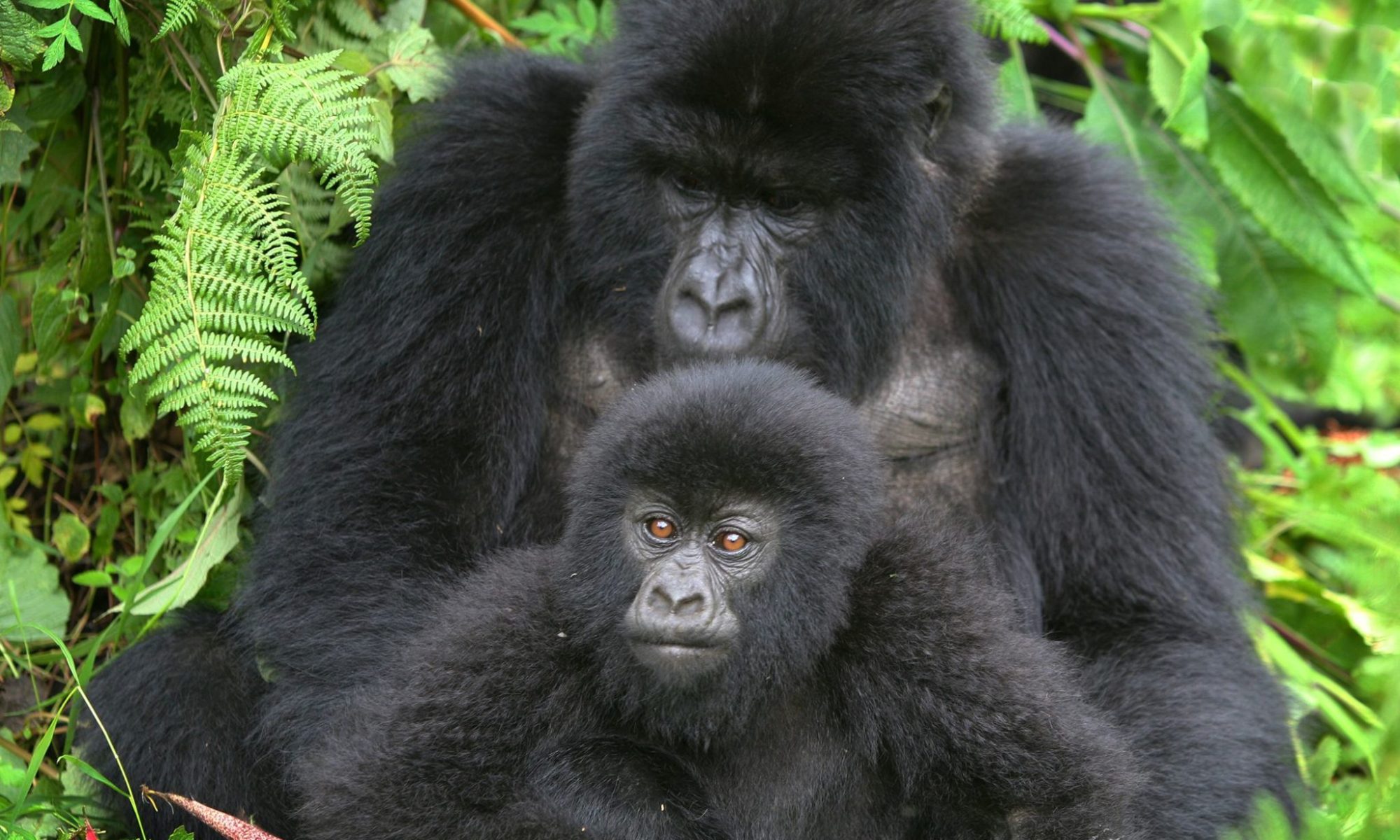
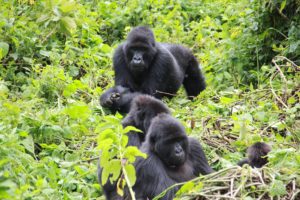
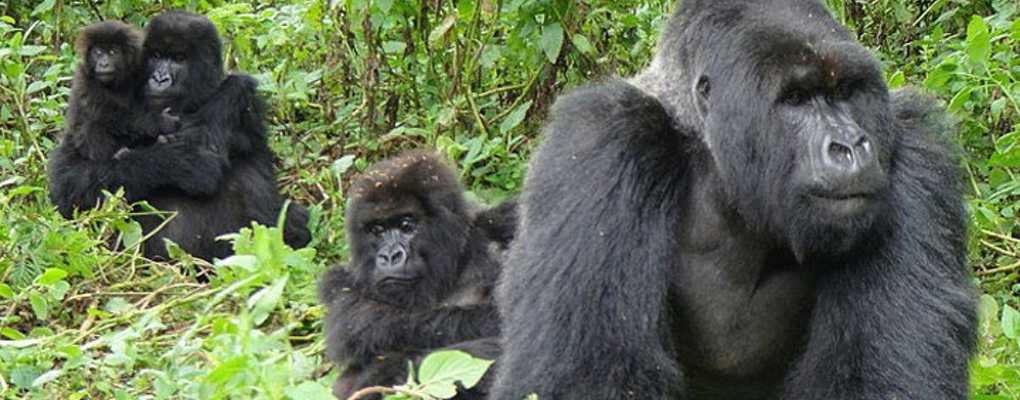
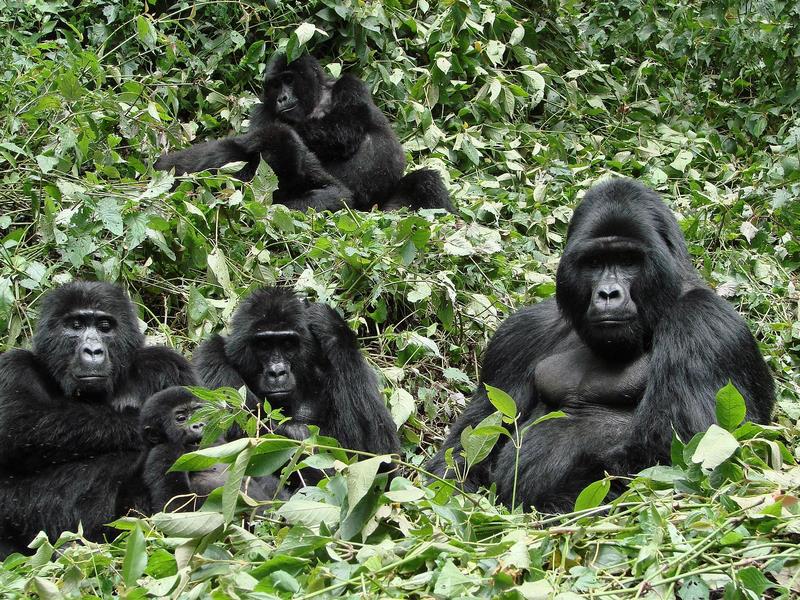
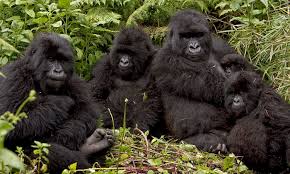
Members of the Nkuringo Gorilla Family, Bwindi Impenetrable N. Park Gorilla trek
Composed of 12 individuals; 2 silverbacks (1 was brutally murdered by poachers in June 2020), 1 blackback, 2 adult females, 2 sub-adults, 3 juveniles and two infants, Nkuringo family is found in Nkuringo tourism sector of Bwindi Impenetrable national park. Nkuringo family was the first gorilla group to be habituated in the entire southern sector of BINP in 1997. Initially, the group had 17 but with time a number of members kept dispersing up to the current size of 12 members. Nkuringo family is also the first gorilla group to record the birth of gorilla ‘twins’ in BINP in December 2004. The group is famously known for foraging outside the park for up to 98% of their time. This practice led to the displacement of the former local human settlers in the frontline villages in Nkuringo sector to create a buffer zone to minimize human-wildlife interface. This displacement followed an outbreak of Scabies in the Nkuringo family in December 2000. Nkuringo family has always been headed by Rafiki. However, in June 2020, a group of 4 hunters speared down Rafiki.
BIKINGI GORILLA FAMILY (EXCLUSIVE FOR GORILLA HABITUATION EXPERIENCE) – 15 MEMBERS
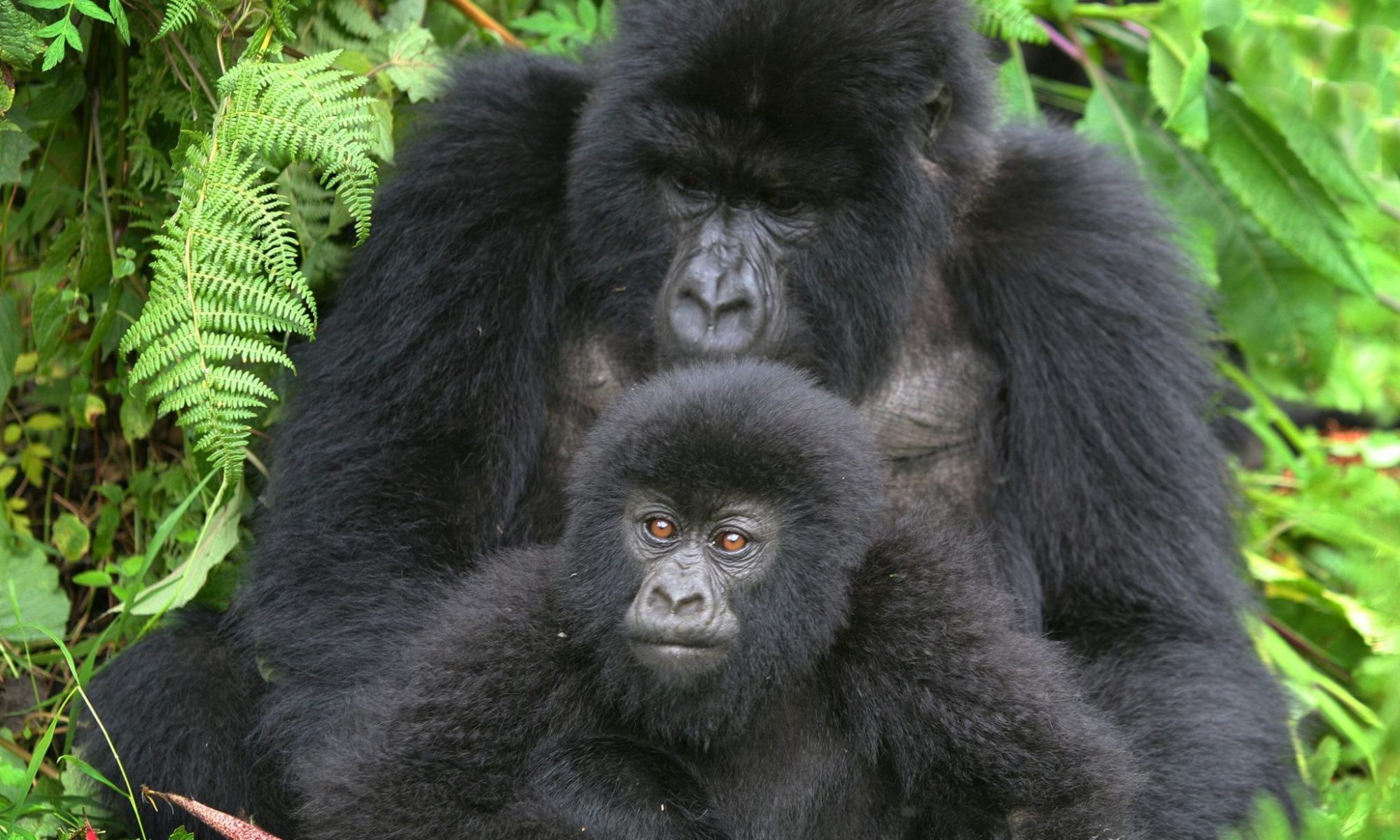
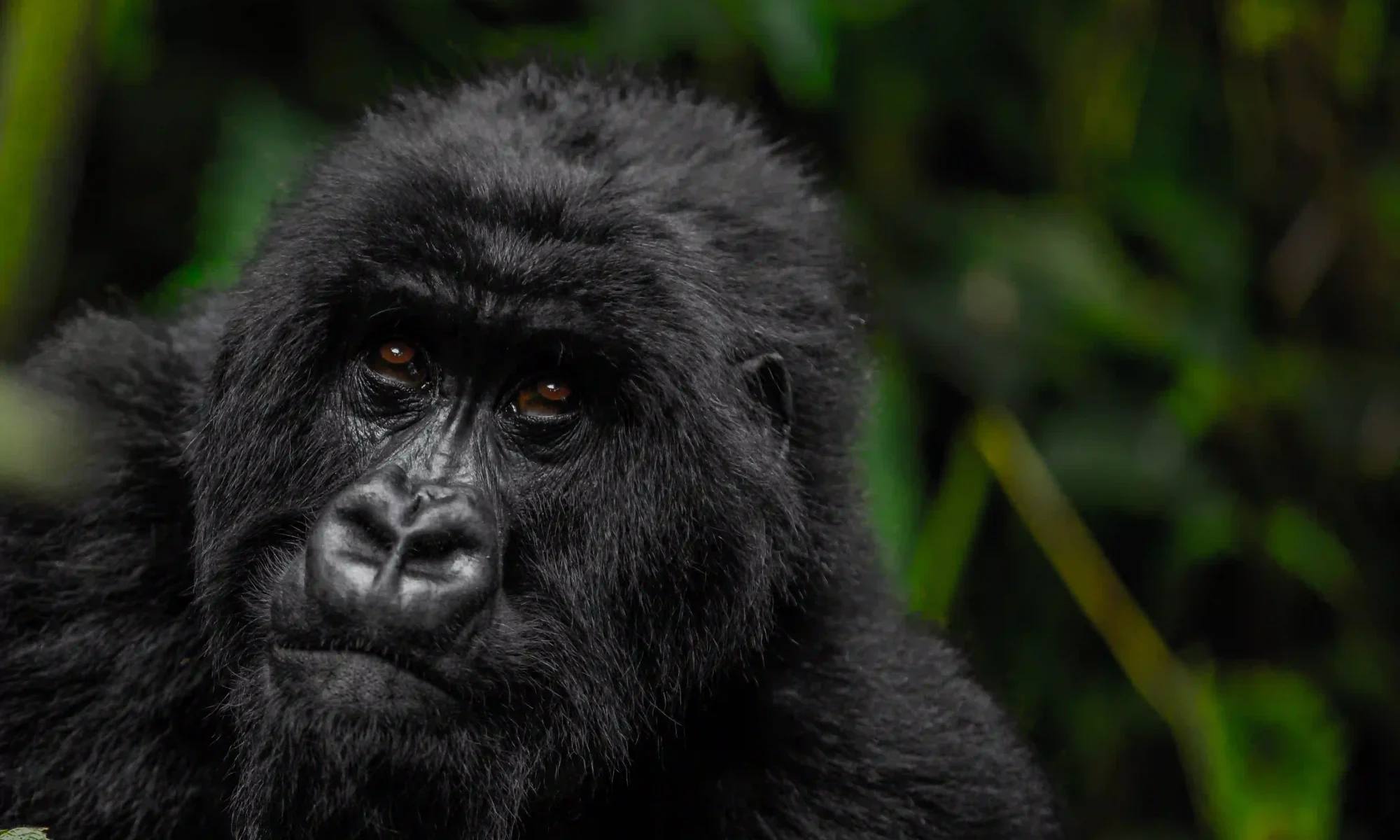
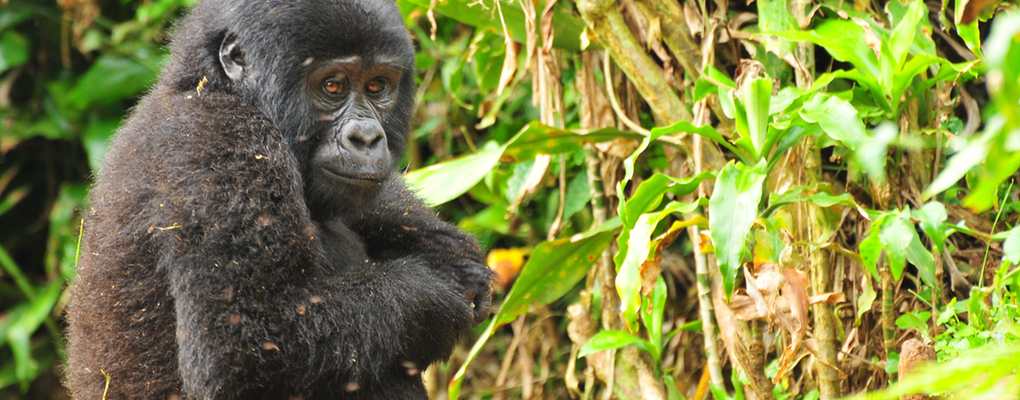
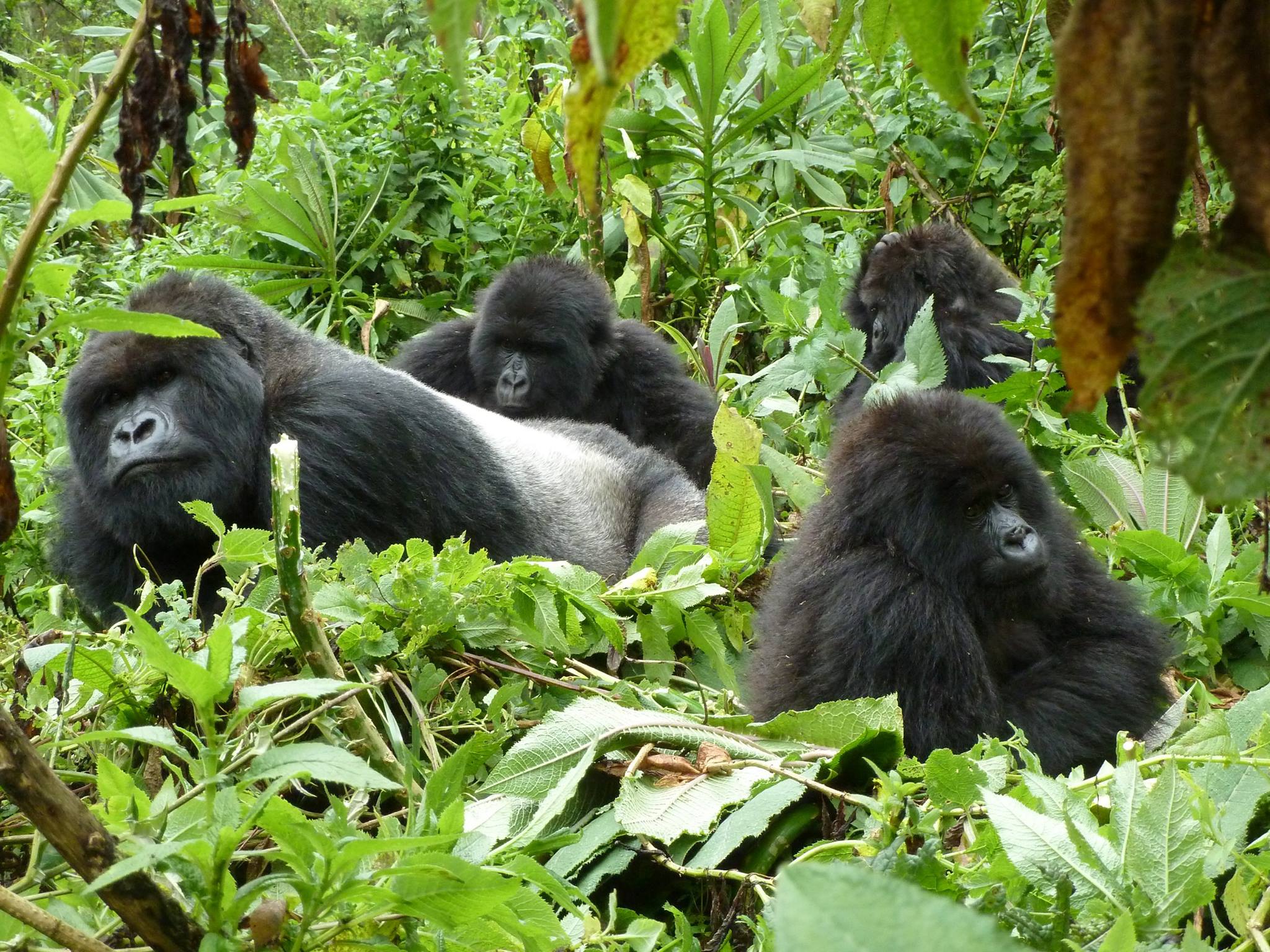
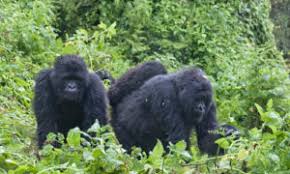
A juvenile mountain gorilla in Bikingi gorilla family Bwindi, Uganda
The habituation of Bikingi gorilla group commenced in early 2012 as a follow-up exercise of the dispersing members of the disintegrated Mishaya family. Indeed, several members of the former Mishaya family were located in the group alongside other non-habituated members and later-on declared for habituation to keep close monitoring of the formerly habituated members. Bikingi family is found in Rushaga tourism sector of Bwindi Impenetrable national park. Unfortunately, this family’s leadership is not yet confirmed because it’s still undergoing habituation. Bikingi family is composed of 15 individuals including; 1 silverback, 5 adult females, 2 sub-adults, 2 juveniles and 5 infants.
BUSHAHO GORILLA FAMILY – 8 MEMBERS
Following a number of individual gorilla dispersals from Nkuringo family, a search for their whereabouts was launched in early 2012. It was discovered that one of the former Silverbacks of Nkuringo family, SB ‘Bahati’ who had dispersed earlier was leading a parallel family. Some of the members in this family were former members of the Nkuringo family among other non-habituated members. What started as a follow-up exercise later led to close monitoring of the behavior of the parallel family. The group was later habituated and named ‘Bushaho’ after the topo-name of the locality where the group forages most. Bushaho family is still headed by Bahati and is found in Nkuringo tourism sector of Bwindi Impenetrable national park. Bushaho family is composed of 8 individuals; 1 silverback, 1 blackback, 3 adult females, 1 sub-adult, 1 juvenile, and 1 infant.
The sunrises an sunsets at Nkuringo are something you need to experience beyond mere pictures but for yourself – there are nature walks such as the Top of the World one, where you look almost endlessly into the Congo – explore the local village of Nkuringo and learn the culture and ways of the people – all within this incredible setting called Nkuringo.
You can take day Walking Safaris from here to the Buhoma area or to Kisoro via a Lake Mutanda boat ride, of course there is Mountain Gorilla Tracking here – you can stay at Nkuringo and track the Nkuringo, Nshongi, Mishaya and Kahungye Gorilla groups, take cultural tours of local village’s, forest walks with guides, Birding and scenic walks, also Mountain Biking.
Related Articles about Uganda Gorilla Trekking, Gorilla Groups, Gorilla Tracking Families and Uganda Gorilla Tours
The total global population of mountain gorillas has risen to1063, according to census data released today by the Uganda Wildlife Authority today, December 16th, 2019. The number of mountain gorillas in Bwindi Impenetrable National Park has increased to 459 based on the 2018 count.
In the area encompassing Bwindi Impenetrable National Park, Uganda, and Sarambwe Nature Reserve, DRC, an area of 340 km2, 459 individual gorillas were found in 50 groups and as 13 solitary individuals. This is compared with an estimated 400 individual gorillas in 36 groups and as 16 solitary individuals from a survey of the same area in 2011.
This is the fifth population count for this area, and the first to include Sarambwe Nature Reserve.
As in the previous mountain gorilla census conducted in the Virunga Massif, survey teams walked pre- determined “recces” (reconnaissance trails) ensuring a thorough coverage of all forest areas to sweep the Bwindi-Sarambwe and search for signs of gorillas, other key mammals, and human activities. When fresh gorilla signs were detected, the teams followed the gorilla trail to locate three recent night nest sites. At each of these nest sites, the teams collected fecal samples from nests. The process was completed twice; first from March to May 2018 (62 days) and second from October to December 2018 (60 days). A second sweep allows to find gorillas that were undetected during the first sweep and thus provides more reliable numbers of gorillas. Fecal samples were analyzed genetically to determine individual genotypes.
The survey teams also collected data on signs and sightings of select mammals, such as chimpanzee and elephants, and human activities, such as snares or tree cutting. While exercising caution due to the limitations of the study, there were no indications of declines in populations for the select mammals surveyed, including elephants, since 2011.
The survey was conducted by the Protected Area Authorities of Uganda and DRC (Uganda Wildlife Authority and l’Institut Congolais pour la Conservation de la Nature, respectively) under the framework of the Greater Virunga Transboundary Collaboration with support from Rwanda Development Board and many other partners and donors.
The greatest current threats to mountain gorillas are entanglement in hunting snares, disease transfer from humans, and habitat loss. The prospect of oil exploration in Democratic Republic of the Congo’s Virunga National Park by petroleum companies is also cause for concern.
5 key facts About Trekking gorillas in Rushaga Sector
If you are tracking mountain gorillas in Bwindi, you will be allocated to trek in either of the 5 sectors of the park, which could be Buhoma, Ruhija, Rushaga, Nkuringo or Nyakagezi.
Rushaga is located in the south of Bwindi Impenetrable National Park, closer to Kisoro town. It is also closer to the Rwanda border in case you will be coming from Kigali for your Uganda Gorilla Trek.
1. How to reach Rushaga Sector
You will have to access Bwindi Impenetrable National Park from its southern side. This means that if you are driving from Kampala, you drive through Kabale area and then branch off to your left as you are on Kabale-Kisoro Road. If you are coming from Kigali, you can enter the border from Katuna or Chanika and then drive to Rushaga Sector.
You can also fly in from Entebbe and land at Kisoro Airstrip from where you can be driven to your accommodation closer to the park. Some guests spend the night in Kisoro town from where they drive to the park next day for the gorillas trek. Flights from Entebbe will normally arrive Kisoro Airstrip at 8 am and depart back to Entebbe a few minutes after that. This means you cannot fly to Kisoro and track the gorillas in Rushaga on the same day. Neither can you track Rushaga gorillas and fly out back to Entebbe on the same day. You will definitely need a night in the park or in Kisoro for any gorilla trekking tour in Rushaga.
If you are driving from Kampala, driving to Rushaga can be ±8 hours journey or if you are driving from Kigali, it will be ±4 hours to the park offices in Rushaga.
2. Gorilla Groups (of Gorilla Families) in Rushaga
Rushaga sector has the highest number of mountain gorilla families and the more gorillas than any other sector of Bwindi. Of the current 19 Mountain gorilla families in Bwindi, 5 of these are in Rushaga sector. You are therefore most likely to be allocated to trek the gorillas in Rushaga on your gorilla tour in Uganda. The cost of gorilla permits in Rushaga is USD600 per person (USD700 from July 2020) and USD1500 if you will be opting for the gorilla habituation experience which allows you 4 hours with the mountain gorillas.
Gorilla Groups/ Families in Rushaga/ Shongi Sector of Bwindi Impenetrable N. Park
SHONGI GORILLA GROUP
7 MEMBERS
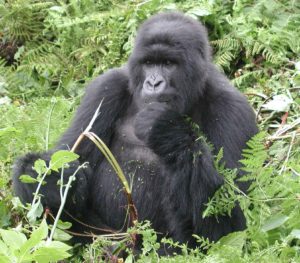
Like Bitukura family, Shongi‘s habituation started in 2006. Initially, this family’s size was as large as 32 members with multi-males but with time intra-male rivalry has caused dispersals of individual members as well as fission. In early 2013, two sections of family members split off the main Shongi group to form the Mishaya family in June 2010 and later again to the current ‘Bweza’ family. Unfortunately, Mishaya Silverback (who had solely led the first splinter section as an adult male died of an obstruction of the intestinal gut on 3rd February, 2014). This resulted into the dispersal of the remnant family members as they had NO other adult male to take lead. Some of the members ended up joining Bweza family while others joined Bikingi family. Today Shongi group is composed of 7 individuals; 1 silverback, 3 adult females, 1 sub-adult, 1 juvenile and 1 infant. Shongi family is headed by Bweza and found in Rushaga tourism sector of Bwindi Impenetrable national park.
BUSINGYE GORILLA FAMILY
9 MEMBERS
Members of Busingye gorilla family were initially habituated as a whole in 2008 with Kahungye family, unfortunately the group broke away in March 2012 creating the Busingye family. This family was named after one of the adult males who led the splinter section to form a new family. Busingye family is fondly known for foraging within the inner forest and very rarely comes toward the park edge. It is found in Rushaga tourism sector of Bwindi Impenetrable national park and is composed of 9 individuals; 1 silverback, 3 adult females, 1 juvenile and 4 infants. Busingye family is still headed by its founder Silverback Busingye.
BWEZA GORILLA FAMILY
12 MEMBERS
Bweza family members were initially habituated in the larger Shongi family until early 2013 when they detached themselves off the main Shongi family to form their own group under the leadership of Kakono. Found in Rushaga tourism sector of Bwindi Impenetrable national park, Bweza family likes to forage on local community land (where vegetation is more disturbed) than in the intact forest areas. This could be its way of freeing from the initial family. Bweza family is currently composed of 12 individuals including; 2 silverbacks, 4 blackbacks, 3 adult females, 1 sub-adult, and two infants.
KAHUNGYE GORILLA GROUP
17 MEMBERS
Initially, Kahungye family size was as large as 29 members with three adult males but due to intra-male rivalry, fission occurred in March 2012 creating the Busingye family. Today Kahungye family is composed of only 17 individuals that include; 3 silverbacks, 3 blackbacks, 3 adult females, 3 sub-adult, 3 juveniles and two infants. Kahungye family is found in Rushaga tourism area of Bwindi Impenetrable national park and is headed by Rumanzi. The habituation of this group started in 2008.
MISHAYA GORILLA FAMILY
This is the group that was formed after it’s separation from the Nshongi family in 2010.
Mishaya, a fighter he is, tore away from his main family with 10 members and has continued to have several fights with other gorilla families.
Apparently, the Mishaya group is made of 12 family members with 1 dominant silverback.
3. Rushaga has highest diversity of optional tourist activities aside gorilla trekking in Bwindi
4. Rushaga is located farthest from other Uganda National Parks
If you are planning on connecting your gorilla tracking with other national parks of Uganda, you will have to bare with longer hours on the road. You need at least 7 hours to connect to Queen Elizabeth National Park, 8 hours to Kibale National Park and a full day drive from Murchison Falls NP (not recommended).
The region where Rushaga is located is dominated by high hills and ridges. The place is beautiful for sightseeing and landscape photographing. The Bwindi forest as well is seen undulating over these hills and if your gorilla trek in in Rushaga, you will be hiking over these hills. The mix of the hills, valleys and ridges makes the gorilla trekking in Rushaga the most adventurous experience. As you trek gorillas from Rushaga you will also enjoy great scenic views and at some points, you can as well see the Virunga ranges in Rwanda and Uganda that include Mgahinga, Muhavura, Sabinyo, Karusimbi, and Bisoke among others. There is Lake Mutanda which is one of the only two lava damned lakes in Uganda. You can enjoy a canoe ride on the lake before or after your gorilla trek.
Rwanda is renowned for its gorillas in the Volcanoes National Park, but the country is also home to chimpanzees as well a host of monkeys – colobus, golden, L’Hoest’s, owl-faced, Dent’s, blue and vervet – alongside olive baboons as well as the nocturnal potto and bushbabies.
Chimpanzees are found in the Nyungwe National Park as well as in smaller number in the Gishwati Forest. Sociable creatures, chimpanzees live in extended communities and move around every day, foraging for food or occasionally hunting smaller mammals. They build fresh nests in the trees each night.
It is common to hear the chimpanzees before seeing them, with their vocalisations reverberating through the forest as they call to each other in a sort of bonding ritual.
Tracking starts early, at 5.30am, and can last anything from an hour to several hours depending on where the chimps are – visitors spend a maximum of one hour with them once they are found.
The terrain can be steep, slippery and muddy, passing through thick vegetation. Suitable footwear is essential, as well as a certain level of fitness. Permits can be booked online, at an RDB office or via a tour operator.
Golden monkeys are found in Volcanoes National Park as well as Gishwati Forest. In the former, there are two groups which can be tracked, one on the slopes of Mount Karisimbi and the other in the bamboo forest on Mount Sabyinyo. This is also a standalone excursion, departing from the Kinigi headquarters once each day.
Now that we are almost learning to live COVID19 pandemic you are certainly already thinking of the missed nature adventures. If you are planning to visit and trek to the mountain gorillas in Uganda in 2022, here is the update on the gorilla tour costs.
Although it might seem that hard to plan, gorilla tracking tours can prove to be the simplest thing to plan. For starters, you only have a few elements to work with and consequently, if you sort these out, you are defined to have the most memorable experience of your lifetime. These revolve around the gorilla tracking permit, accommodation on the gorilla trek tour in or near Bwindi, the transportation to Bwindi and back to the airport and of course your international flight ticket if you are coming from outside of Uganda.
I try to help you plan your gorilla trekking tour in the most convenient way possible in this article. I also try to ensure that you have a lower cost for your Uganda gorilla trekking tour. Most of the gorilla tour costs shared here are based on the year 2020 and 2021. Some things might change along the way, so I advise you to check with your tour operator for the most updated gorilla tour prices at the time you are trying to book the gorilla trek.
First, the cost for the Uganda gorilla trekking permit is USD700 and the cost for a gorilla habituation experience permit is USD1500. You can contact a reputable Uganda safari company to help you get the gorilla permits.
How much would a Gorilla Trek Safari Cost in 2022 in Uganda?
Here are the current gorilla tracking tour prices for Uganda, based on when you are going in July 2020 or after. This is for the 3 Days Uganda Gorilla Tracking tour, the most commonly requested for a gorilla safari.
Midrange: Ichumbi Lodge/ Silverback/ Lake Mulehe/ Engagi Lodge
Upscale: Mahogany /Nkuringo/ Buhoma Lodge
Super Upscale: Gorilla Forest Camp and Clouds
1 person cost of gorilla tour
USD2,544
USD2,931
USD 3,350
USD 4,995
Gorilla tour cost based on 2 persons (per person sharing room)
USD1,973
USD2,183
USD 2,586
USD 3,844
Gorilla tour cost based on 3 persons (per person sharing room)
USD1,874
USD2,083
USD 2,487
USD 3,744
Gorilla tour cost based on 4 persons (per person sharing room)
USD1,824
USD2,034
USD 2,437
USD 3,695
Gorilla tour cost based on 5 persons (per person sharing room)
USD1,794
USD2,004
USD 2,407
USD 3,665
Gorilla tour cost based on 6 persons (per person sharing room)
USD1,774
USD1,984
USD 2,387
USD 3,645
Gorilla tour cost based on 7 persons (per person sharing room)
USD1,760
USD1,970
USD 2,373
USD 3,631
Single Room Supplement
USD60
USD 225
USD240
USD 600
What is the price for accommodation for gorilla trek in Bwindi:
For accommodation on gorilla trekking, the cost will largely depend on your budget. There are places for as low as USD70 per night like Gorilla Havens; USD150 per night at Lake Mulehe Gorilla Lodge, Clouds Mountain Gorilla lodge for about $1000 a night among others. Bwindi offers several other accommodation for the gorilla trek and you could also do come with your own tent and camp at places like Buhoma Community rest camp, gorilla friends resort among others.
What other expenses should one consider when going on a gorilla tracking tour in Uganda?
Apart from the standard cost for gorilla tracking, expect to incur other costs while on the gorilla tour. It is normal to give a tip to the gorilla trek guides after the trek. This is usually $10-$30 for the head guide. You might need a porter for the trek who can easily be hired at the trek starting point, which usually costs $15 per porter. You will also need plenty of water for the gorilla trek
When is the best time to trek mountain gorillas in Uganda?
Most gorilla tracking in Uganda happens during the months of January February, Mach, June, July, August, September, and October. The gorilla trekking these months is quite easier because there is almost no rain in Bwindi. But also it is easy for photographing the gorillas in Bwindi. The months of June, July, and August are popular for gorilla trekking because they are also the summer holiday months in Europe, which is the main source market for Uganda gorilla trekking.
But also, it is a bit more expensive to visit the gorillas these months because flights are more costly and accommodation as well.
Which is the Cheapest Time for Gorilla Trekking, Most Cheap gorilla Trekking Time?
You can get the cheapest gorilla trek tour in April, May, November. At this time, Uganda gorilla tour operators will offer very cheap gorilla trek tours. Also, accommodation for gorilla treks is cheaper, and flights to Uganda are cheap.
Which are the other recommended gorilla tracking tour packages in Uganda?
2024 detailed gorilla trek cost comparison of gorilla trekking Uganda Rwanda, prices for gorilla trekking in Rwanda and Uganda, Gorilla tour prices; Which is the best place to do a gorilla trek – Uganda or Rwanda? Are gorilla trek tours cheaper in Uganda or Rwanda and why? Bwindi or Volcanoes National Park, which is easier to access, Is tracking Rwanda better than Uganda?
If you looking for prices for Rwanda gorilla trekking tours, we have them listed at Gorilla Trekking Cost Rwanda.
Rwanda Vs Uganda: Compare 2024 Gorillas Trek Tours, Gorilla Trekking Cost, Experiences In comparing gorilla trekking Uganda Rwanda, we have to first look at the costs involved.
Okay, aside from the price differences with the Rwanda gorilla trekking permit now at $1500 and Uganda gorilla going for $800, could there be some real difference in the experience one finally gets? As all the mountain gorillas in both countries are the same species only separated by national boundaries, the only difference that should mainly arise is in your experience in the tracking and the general gorilla tour arrangement. Because Rwanda’s Volcanoes National Park is only about 125kms from your arrival airport – Kigali, it makes it much easier to access by road. For Uganda’s Bwindi/ Mgahinga, you would need 8 hours to drive from Entebbe Airport and another 8 hours back to the airport, although daily flights are available (taking about 50 minutes). With this prevailing, you would need at least two days to complete your gorilla tour in Rwanda and 3 days for a Uganda gorilla tour. So, even though the Uganda gorilla’s permits are cheaper, you would incur a transport cost of about $600-$700. Some visitors choose to arrive in Kigali and arrange to visit Bwindi from Kigali. You would still need 3 days for the entire tour.
All else being equal, Rwanda’s Volcanoes National Park has a slight edge over the rest because its gorillas are the most wholly habituated, and they are often found in bamboo than the dense forest which makes photographing easier. The major challenge with trekking gorillas in Rwanda is certainly the price of the gorilla permit at US$1500 compared to Uganda’s US$800. However, Rwanda’s pride is in the ability for one to do the gorilla trek even in one day and fly back home which is impossible for Uganda. Volcanoes National Park is located 116 km from Kigali and can be driven in just 2 hours. On the other hand, Bwindi is located 500 km from Kampala/ Entebbe Airport and a drive can take 8 hours plus. In that sense, you will spend at least 3 days for your gorilla trek tour – one traveling to Bwindi, another doing the gorilla trek, and the other driving back to Kampala/Entebbe. If a tour operator is making you a tour package, they shall definitely have to consider this cost and include it in your tour cost. With the oncoming of daily scheduled flights to Bwindi, operators now can have 3 days flying packages to Bwindi. In real practice though, the one-day gorilla trek tour is not recommended because of the pressure it exerts on the trekker. For those limited on time, we would suggest the 2-days gorillas package.
However, the long drive to Bwindi is quite enchanting with great sceneries all through like the Equator, Lake Mburo National Park ( for some Queen Elizabeth National Park with abundant wildlife), terraced mountains with flowing rivers, and a lot of rural Africa. This is not so really the case for the drive from Kigali to Volcanoes National Park.
You will certainly spend more on transport and time to track the mountain gorillas in Uganda than it’s for Rwanda although this cost is compensated for by a cheaper gorilla permit.
Besides, some sections of the roads to Bwindi Impenetrable National Park are not so comfortable to drive on yet in the case of Rwanda, you drive on the smooth tarmac at least up to the Volcanoes National Park head office. Not to mention though, the roads leading from the Volcanoes park office to the gorilla trek trail-heads can only be accessed with a raised 4×4 vehicle.
Where will I get the best Gorilla Trekking Experience in 2024 – Uganda or Rwanda?
In general, the experience can only be different due to the way a particular gorilla family behaves in front of the trackers, how long and tough one has to track before reaching the gorillas, and the way the park staff conducts the exercise. Personally, I found the Rwanda gorilla tracking package more charming than the Ugandan one on the tracking day. Should we say that this’s because of the gorilla permit price difference? Anyways, on your gorilla tracking day in Rwanda, you will definitely get more than that. At about 7:00 AM, tea/ coffee dispensers with cups are laid for visitors going for the trek. You are free to take as much as you wish. As visitors are enjoying the tea/ coffee, they are entertained by the lively traditional dance troupe (SACOLA Traditional Dancers) who bring on a wholesome Rwanda traditional cultural experience all visitors enjoy.
Of course, you can get this in Uganda in the evenings (at a fee) from the various traditional cultural groups that are near the park. However, the drive from Kampala to Bwindi is a very fabulous one traversing at least another national park (either Kibale or Queen Elizabeth National Park famous for tree-climbing lions and many other big mammals, or Lake Mburo National Park) and not to miss- the Equator. In a way, even before you arrive in Bwindi you have had a bit of the ‘Pearl of Africa’ as is fondly known. To many, driving along paved eucalyptus avenues to the gorillas is not the best deal. Indeed many do purchase tour packages combining both Rwanda and Uganda, first doing Gorillas in Rwanda and then crossing to Uganda to visit Queen Elizabeth National Park for the BIG 5 safaris and chimpanzee tracking among other tours.
How expensive is gorilla tracking tour, which is more expensive, is Rwanda more costly than Uganda?
Because of the long drive, one endures from Kampala to Bwindi, the general cost is increased (even when you travel by public buses). It even increases more because you have to travel 2 days (to and from Bwindi). However, the increased cost is countered by the low-cost gorilla permit of US$700. If you are 2 persons, the cost of a Uganda gorilla trek tour is $1152 per person in lower budget accommodation and if you are solo the gorilla tour price is USD1400 for the 3 days gorilla trek tour in Uganda including the gorilla permit, accommodation, and transport) for one person on tour. The two days Rwanda gorilla trek costs about $1950 ( with gorilla permit, accommodation, and transport), and a three days Rwanda gorilla tracking tour costs is about $2030 (with gorilla permit, accommodation, and transport).
In case you are willing to camp, the Uganda 3 days camping gorilla tour is about $1230 for 1 person, $998 per person if 2 persons. This comes with a nice tent, camping mattress, sleeping bag, the gorilla permit, transportation, and breakfast.
What other differences are there in gorilla trekking safaris between Uganda and Rwanda?
Lastly, if you are not traveling just to see the mountain gorilla, and you want to include other activities in your visit, Rwanda may not be the best choice. Many tourists have continually had to cross to Uganda after their Rwanda gorilla trek to tour other reserves like Queen Elizabeth National Parks so endowed with abundant wildlife one cannot see in Rwanda. This is why probably folks continue enduring the long drives to Bwindi yet there is an easy way out.
At the end of the day – the ultimate jury is those who are looking as to which country to visit in order to track Gorillas – it is not Rwanda, not Uganda, not the Democratic Republic of Congo but where their pockets and hearts choose. If you precisely want the mountain gorillas and nothing else, go for a one-day gorilla trek but if you are one who wants it and all of it, go for the long drive – you won’t regret it…
Have you been on a gorilla trek in Rwanda or Uganda? What was your experience? What have you had about tracking gorillas in Rwanda Vs Uganda? Let me hear your views on comparing gorilla trekking Uganda Rwanda as well.
How much is the Rwanda Gorilla Tour Trekking Volcanoes National Park (including gorilla permit, accommodation, and transportation)?
For the best Rwanda Gorilla trekking tour experience, we suggest the 3 days Rwanda gorilla tour. The lowest cost for this gorilla trekking tour is USD1850 per person if you are 4 person sharing rooms, USD1960 per person if you are 3 person sharing rooms, USD2100 per person if you are 2 person sharing rooms, or USD2500 if you are 1 person going on the gorilla trek alone. If you are staying at midrange lodges like Le Bambou Gorilla Lodge, Da Vinci Gorilla Lodge, the cost of your gorilla trekking tour is USD2000 per person if you are 4 person sharing rooms, USD2070 per person if you are 3 person sharing rooms, USD2237 per person if you are 2 person sharing rooms, or USD2700 if you are 1 person going on the gorilla trek alone. Please contact us for more updated offers here>>>
What is the Cost of Rwanda Gorilla Trekking Tour in Mid-luxury lodges?
And if you are staying in mid-luxury lodges like Five Volcanoes Lodge, Mountain Gorilla View Lodge the cost of your gorilla tour is USD2107 per person if you are 4 people sharing two rooms, USD2150 per person if you are 3 people sharing a triple room, USD2290 per person if you are 2 persons sharing a double/twin room, or USD2820 if you are 1 person going on the gorilla trek alone.Please contact us for more updated offers here>>>
How much is a Luxury Rwanda Gorilla Tracking tour?
Luxury lodges for Rwanda Gorilla Trekking include Virunga Lodge, Silvrback Savibyo Gorilla Lodge among others. If you will be staying at these luxury lodges, the cost of your gorilla trekking tour is USD3370 per person if you are 4 person sharing rooms, USD3400 per person if you are 3 person sharing triple rooms, USD3580 per person if you are 2 person sharing rooms.Please contact us for more updated offers here>>>
What is the cost of a 2 Days Rwanda Gorilla Trekking Tour?
If you are planing only two days gorilla trekking tour, the prices for your gorilla trekking is as follows:
The cheapest Rwanda gorilla trek tour when you stay at Kinigi Guesthouse is USD2100 if you are 1 person on tour. USD1850 per person if you are 2 persons sharing room, USD1775 if you are 3 people sharing a room and if you will be 4 persons sharing 2 rooms – USD1736 per person
If you are staying at Le Bambou Gorilla Lodge: 1 person on tour – USD2300; 2 persons sharing room – USD1940 per person, 3 persons sharing room – USD1840 per person, 4 persons sharing 2 rooms – USD1790 per person.
If you are staying at Mountain Gorilla View Lodge or Five Volcanoes Lodge: 1 person on tour – USD2380; 2 persons sharing room – USD1950 per person, 3 persons sharing room – USD1920 per person, 4 persons sharing 2 rooms – USD1860 per person.
More Recent Tour Report images from Gorilla Tracking Safaris in Uganda and Rwanda
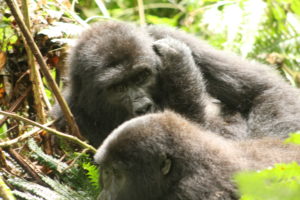
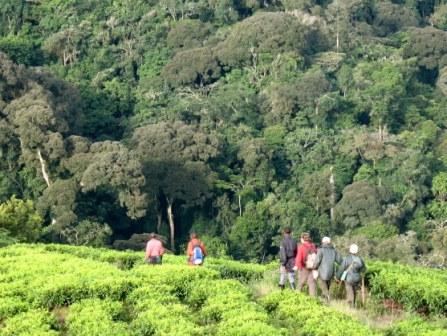
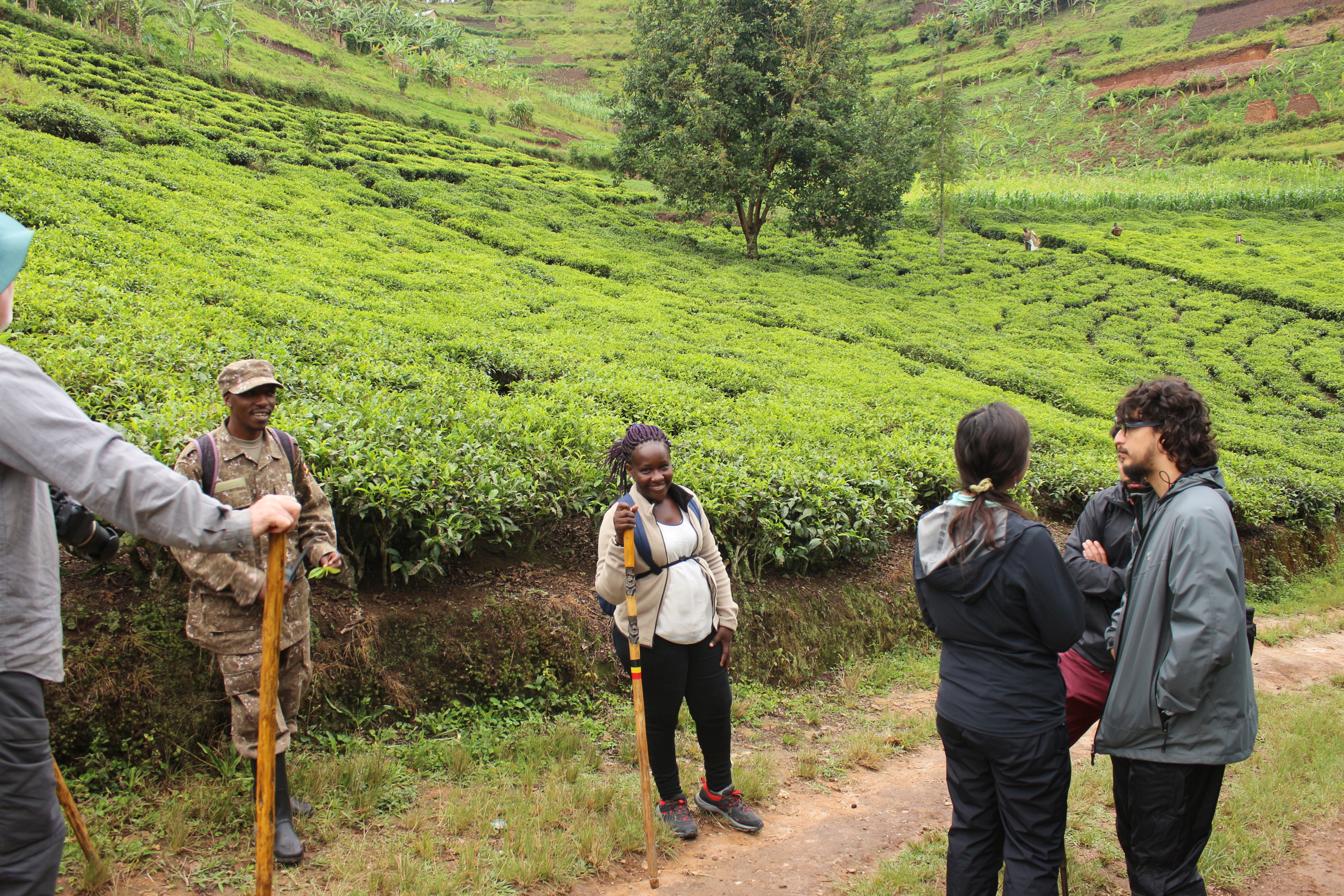
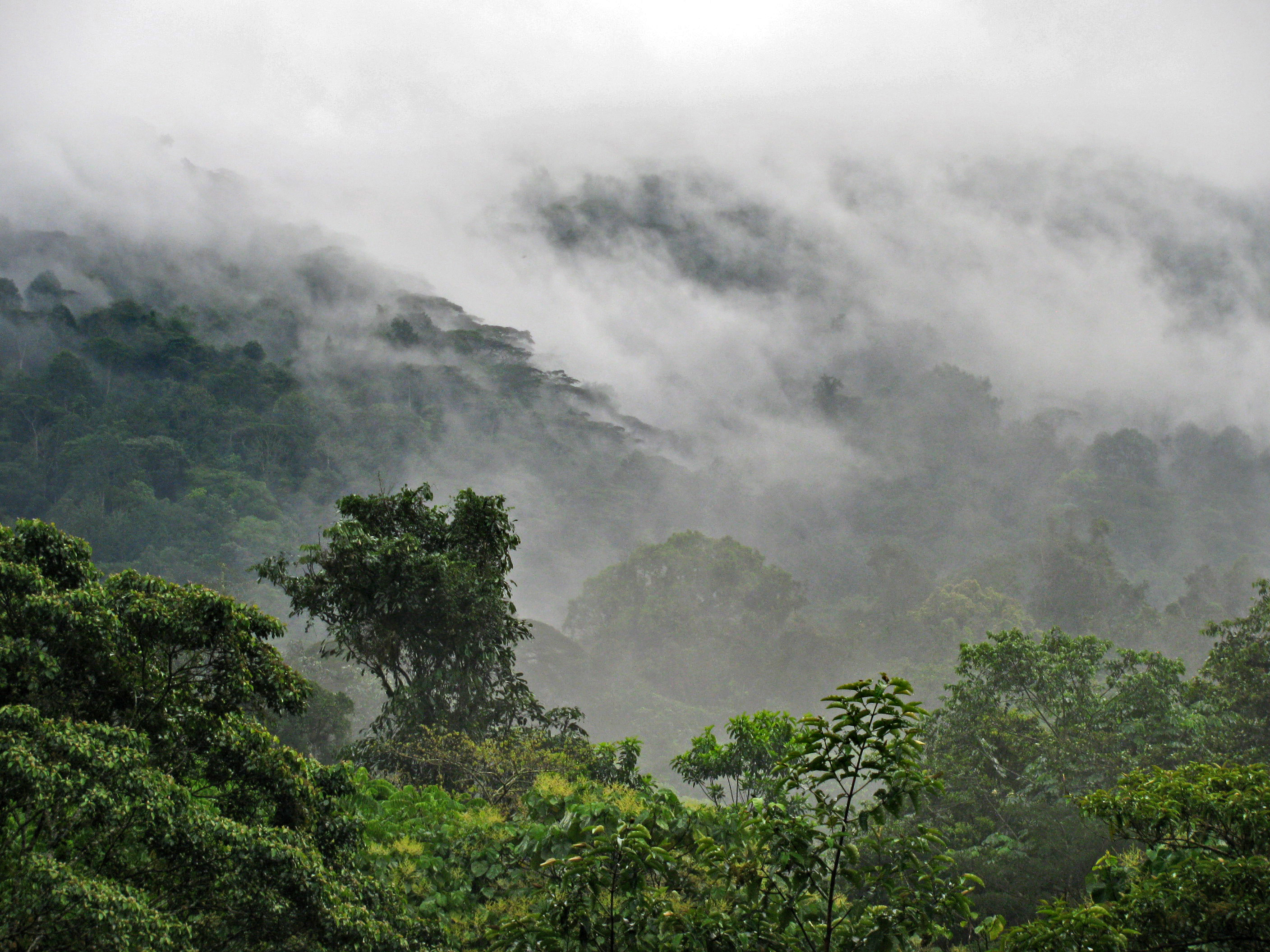
Tourists about to trek gorillas in Bwindi, UgandaViews of Bwindi Forest on this Uganda Gorilla Trek TourBwenge Gorilla Group in Volcanoes National Park Rwanda
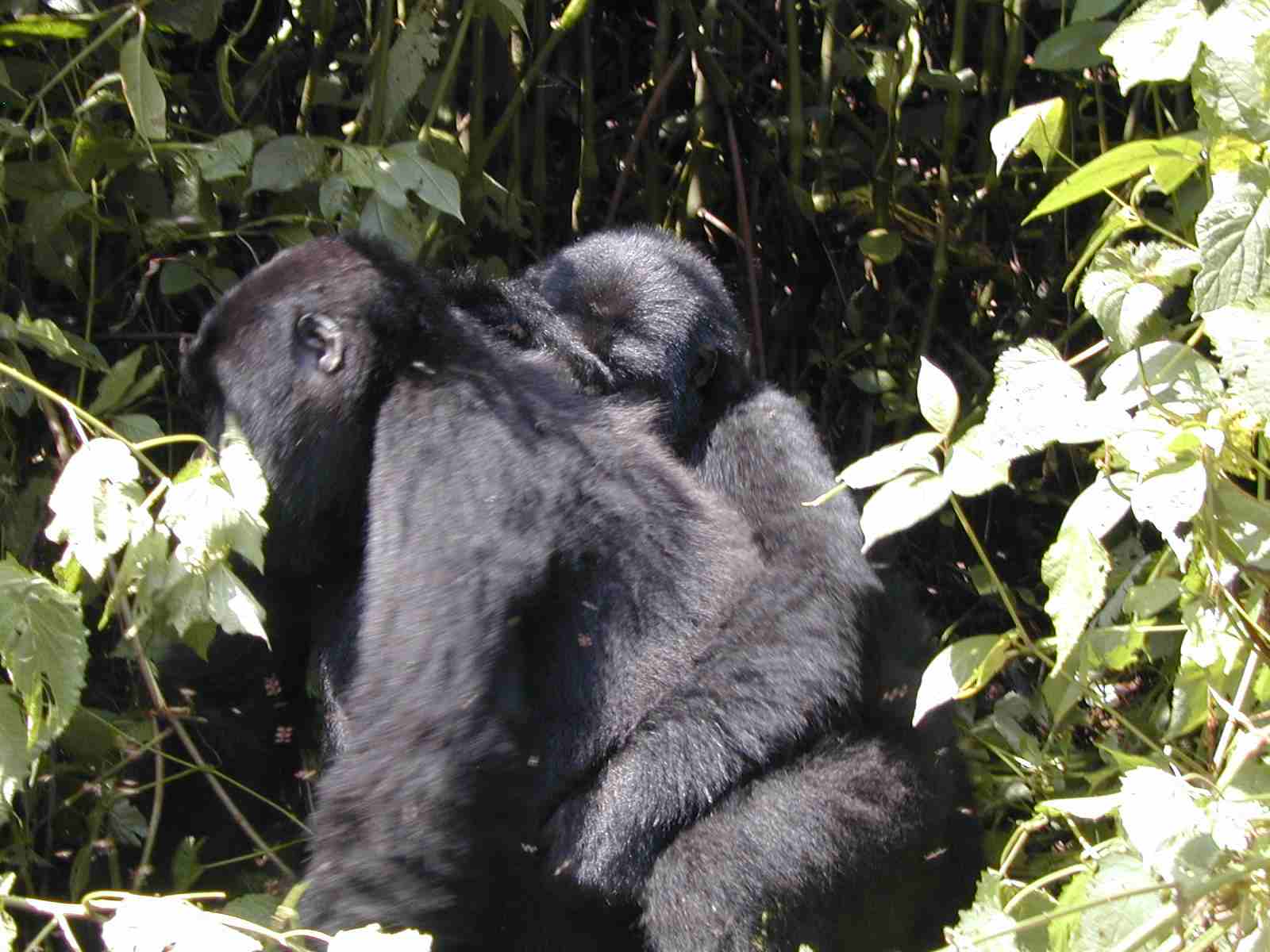
Bwindi Mountain gorilla with baby gorilla – Uganda
Mount Bisoke (also Bisoke) is an extinct volcano in the Virunga Mountains of the Albertine Rift, the western branch of the East African Rift. It straddles the border of Rwanda and the Democratic Republic of the Congo, but the summit is located in Rwanda. It is located approximately 35 km northeast of the town of Goma and adjacent Lake Kivu.
The mountain is located within Rwandan Volcanoes National Park and Congolese Virunga National Park. The steep slopes of the peak are densely covered with equatorial rainforest and alpine meadows. The summit does not gather snow but is often shrouded in fog. Bisoke is one of the mountains considered a habitat for the endangered mountain gorilla, and the Karisoke Research Center founded by Dian Fossey is located in the valley to the west.
Mt Visoke stands at 3700m, it has the typical conic shape of a “perfect” volcano and in its crater lies a deep crater lake. For those interested in climbing Mt Visoke the volcano does not present an exceptionally demanding climb, but it is nevertheless still a tough hike. The high elevation demands extra strength of climbers and the whole excursion can take between 5 hours and the whole day depending on the speed of the walk and the frequency of stops. The ascent typically takes around 3 hours.
An eruption in 1957 formed two small cones on the north flank, 11 km from the summit. The walk around the crater rim is highly recommended. Allow seven hours for the entire trip. Lake Ngezi (9,843 ft./3,000 m), a small, shallow crater lake, is the easiest hike in the park; it takes only three to four hours round-trip from the Visoke departure point.
During the climb, you will cross a series of different vegetation habitats starting with bamboo forests, then moving into Hagenia – Hypericum forest and finally moving through Senecio – Lobelia bush near the summit.
Current Park fees for the climb are USD$ 75 per person, this includes the park’s guide and can be purchased on the day of the trek from the park’s headquarters, no advance booking is necessary. The trek starts at 07:00 am from the Park’s headquarters in Kinigi from where visitors will drive/be driven to the start point of the trek. Porters can also be hired from the park headquarters.
How to securely book 2026 Uganda gorilla tracking and trek permits for your tour in Uganda’s Bwindi Impenetrable National and Mgahinga Gorilla National Park –
This is the most secure step-by-step illustration of how you can buy the Uganda gorilla permit for your trek for 2026. Currently, only Ugandan-accredited tour operators can buy permits from the Uganda Wildlife Authority. Gorilla trek or Chimpanzee trek permits can either be booked together with your tour package or by Uganda Uganda-based tour operator who is a member of the Association of Uganda Tour Operators, or independently of a tour package but through a Uganda-based tour operator. The only secure way to book Uganda gorilla trekking permits is through a tour operator who is a member of the Association of Uganda Tour Operators and is licensed by the Uganda Tourism Board. Anything else is not secure.
Each Uganda gorilla permit costs US$800 while the gorilla habituation experience permit is USD1500 per person per visit. On each particular day, up to about 120 persons can visit Bwindi gorillas, 8 persons per gorilla family/ gorilla group. Gorilla Permits for Bwindi can only be purchased from Uganda Wildlife Authority (UWAs) headquarters in Kampala, directly through a tour agent.
Booking Uganda Gorilla Permits Directly Through UWA
As of 2025, Uganda Wildlife Authority is no longer taking direct visitor bookings for gorilla permits. When you contact them, they will gladly redirect you to a tour operator who is a member of the Association of Uganda Tour Operators, or to the Uganda Tourism Board Website for tour operators. To ensure that your gorilla permit is securely booked, please check out the reputation of the tour operator you are working with.
Securely Booking Your Gorilla Permits Through a Ugandan Tour Operator
Because Uganda Wildlife Authority demands that all gorilla trek permits must be booked through a locally based Uganda tour operator, you will have to find one to book your gorilla permit safely. Ugandan tour operators who are allowed to book gorilla permits are either members of the Association of Uganda Tour Operators or are accredited by the Uganda tourism board to operate gorilla tracking in Uganda. The tour operators will usually charge a fee of US$25-$50 per gorilla permit. We can also help you securely book gorilla tracking permits. Gorillas and Wildlife Safaris will not charge you for buying gorilla permits if you are getting other tour services (like transfers and tours) through them but if you would only like us to help you acquire the gorilla permit alone, a maximum of $35 applies on each gorilla permit we book.
The procedure is almost similar to the above, except that the tour agencies tend to speed up the process, and most likely, you will get your gorilla permit confirmation faster.
Gorillas Habituation Experiences and Other Primates Habituation Experience Tours in Uganda
TOP 10 TOURIST ACTIVITIES IN MGAHINGA GORILLA NATIONAL PARK, WHAT TO DO IN MGAHINGA
INFORMATION ON ACTIVITIES IN MGAHINGA GORILLA NATIONAL PARK, KISORO; BATWA TRAIL, GARAMA CAVE, SABINYO GORGE, LAKE MUTANDA, MT MGAHINGA Kisoro is home and the main base for gorilla trekking in Southwestern Uganda and neighboring Rwanda. However, Kisoro doesn’t only offer gorilla trekking: Its beautiful surroundings offer an opportunity to undertake several different interesting activities, either individually or in groups. Below is a description of some of these activities.
GORILLA TREKKING IN MGAHINGA
Mgahinga Gorilla National Park is home to Nyakagezi gorilla family. The gorilla trekking starts at the park headquarters. You will need to plan your gorilla trekking tour in advance because permits sellout usually 3 months in advance. The gorilla trekking in Mgahinga is usually shorter than the treks in Bwindi although the terrain might be more rigged.
2. Batwa Trail
Batwa Trail is a community based tour product developed by the Batwa community near Bwindi in conjunction with the Uganda Wildlife Authority and Pearls of Uganda an NGO:- It starts at the base of Mt Muhavura at 8.00 am and finishes by 3-4 pm. You’ll need walking shoes, hat, and raingear, and a packed lunch with sufficient drinks. The Batwa Trail runs across the lower slopes of the Muhavura and Gahinga volcanoes in Mgahinga Gorilla National Park. The forest is home to a variety of wildlife but the Batwa Trail is far from being a conventional nature walk. With the help of Batwa guides, you’ll see the forest as a larder, pharmacy, builder’s yard, tool kit and, above all a home. Along the trail, you’ll fire a bow and arrow, check hives for wild honey, help repair a Batwa shelter, harvest plants for medicine and food, light a fire without a matches, listen to legends and learn about Batwa traditions. The highlight of the trail is a descent into the Garama cave, a 200m-long lava tube beneath Mt. gahinga. The Batwa are famed for their music and dance and their historic, subterranean council chamber in Garama Cave provides the setting for an unforgettable performance. The Batwa trail is celebration of the forest culture of the “‘first people.” It is impossible, however, to ignore the fact that Batwa life has greatly changed. The day’s events conclude with a discussion about the Batwa’s current situation; how it can be improved; and progress to date towards doing so.
3. Golden monkey Tracking in Mgahinga
The Golden Monkey may not be the most well known primate, but is certainly an enjoyable, little creature that is worth visiting. It is a small curious monkey, golden in colour and loves to scamper around the trees. Golden monkeys are named after their golden-orange fur, and like mountain gorillas, are also considered endangered species. Conservation efforts have been put in place by the Uganda Wildlife Authority to ensure that the monkeys are protected – especially from poachers.
There is a habituated family of monkeys in Mgahinga, where tourists can track and stay with them for a period of four hours depending on where they nested the previous night and how far it is from the starting point.
It is estimated that Mgahinga Gorilla National Park has between 3000-4000 golden monkeys grouped in troupes of 30s led by a principal adult male. Golden monkeys are primarily to be found in the bamboo forest that skirt the lower slopes of the volcanoes. They are quite more active in the bamboo canopy. Golden monkeys are opportunistic feeders. What they feed on could be by the availability of fruits, leaves of bamboo trees, shoots of bamboo, shrubs, flowers, invertebrates and these makes it to be restricted to highland forest, mostly the bamboo forest.
Golden monkey tracking starts at Mgahinga Gorilla National Park headquarters at 7:30am for pre-tracking briefing (on the dos and don’ts of tracking the golden monkeys). The actual trek begins at 8:00am. Hiking through the forests to sight the golden monkeys is not so strenuous like gorilla trekking because golden monkeys live in lower areas, so tourists do not track for more than 3 hours. When tourists encounter the golden monkey family, they are given one hour (0r 4 hours in case your are doing the habituation experience) to spend with them (to take photographs and observe their behavior). With this activity, there is no minimum number of tourists who track each group and age limit is 12 years.
Golden Monkey Habituation Experience in Mgahinga
Uganda Wildlife Authority now offers you the golden opportunity to experience a Golden Monkey Habituation in Mgahinga National Park. Accompany the researches in the morning or afternoon to track the Golden Monkeys and stay with them for 4 hours. You will have the unique chance to get close to these little primates and study their behavior in their natural habitat. A unique experience that will enhance your primate safari in Uganda!
What to carry during Mgahinga golden monkey tracking.
There are several requirements that tourists need to have a memorable experience during golden monkey tracking. These include waterproof hiking boots, wear long sleeved shirt, long trousers, and carry a backpack for your lunch and documents. Also carry drinking water and snacks, carry a walking stick to support you during hiking, you can hire a porter to support you during hiking in slippery places and they carry your backpack, and do not forget to carry an insect repellant.
4. Viewpoint
Just above Ntebeko Gate is a small platform offering a magnificent view of Magahinga National Park and the surrounding area. To the south the three volcanoes, to the north miles of small gardens, Lake Mutanda and the hills of Bwindi Impenetrable Forest. To the west a great view of the Western Rift valley in Congo. Difficulty: easy; walking time: 30 min; distance 1km
5. Garama Cave
Almost 100 years ago there was a conflict between the Batwa (pygmies) and the Bantu population. The Batwa lived in the forests and the Bantu had their gardens and villages. The Batwa raided the Bantu in their villages and disappeared in the forests. The Bantu had no idea that there was a very large cave in the forest where the Batwa were hiding. Garama cave is 342 meters long and today it is only home to bats. During the visit the guide will tell you more about Garama Cave and the history and the life of the Batwa. Difficulty: easy; walking time: 3 hrs; distance 4 km. NB: bring a torch!
Around 58% of Magahinga National Park is covered with bamboo forest, a delicacy for the Gorillas and the Golden Monkeys. The walk to the top of the Mgahinga Volcano takes us through a very nice example of pure natural bamboo forest. This walk offers a good chance to see the rare Golden Monkey and Bushbucks. At the top (3474m) you will find a good view and a lush swamp in the crater. Difficulty: moderate; walking time: 6 hrs; distance 6 km; elevation gain: 1100 m.
Mount Sabinyo is the oldest of the three volcanoes, quite eroded and that is why it has its name, which means: “teeth of the old man”! This volcano has three challenging peaks. The trail takes you up a ridge along the eastern side to Peak 1. If you wish to continue, the climb to Peak 2 involves walking a ridge with breathtaking drops into the gorges of Rwanda and Uganda. Finally, the hike up to Peak 3 is steep with several ladders and much scrambling. On top of peak 3 (3669m) you will be in Rwanda, Uganda and Congo at the same time! The Sabinyo hike takes you through all different vegetation belts, and you have good chances of seeing Golden Monkeys, Duiker, Rwenzori Turacos and Sunbirds. Difficulty: you have to be fit! walking time: 8 hrs; distance 14 km; elevation gain: 1300 m. NB: bring good walking shoes!
7. Sabinyo Gorge
This walk takes us through the lush vegetation in the gorge of the Sabinyo. It is moist with a dense vegetation. A small river at the bottom of the gorge is responsible for creating this paradise over time. At the end of the walk is a small but nice waterfall and a very good view of all the peaks. A good place for lunch! The gorge is a good place for seeing birds, especially the Ruwenzori Turacoo. Golden Monkeys and Duikers can also be spotted. Difficulty: moderate; walking time: 4 hrs; distance 6 km; elevation gain: very little. NB: bring good walking shoes!
8. Border Trail
This hike takes you first toward Sabinyo. The trail climbs up the base of Sabinyo for a while through fine montane forest before turning towards Congo. Along the way you will get a great view of Sabinyo’s gorge and peaks. Upon reaching Congo you cut back along the international border. The return leg to park head quarters is a great section for birding. The two rest huts along the way are good places for a break. Look closely for the Golden Monkeys and signs of elephants. Difficulty: moderate; walking time: 8 hrs; distance 10 km; elevation gain: very little. NB: bring good walking shoes!
9. Free Birding in Mgahinga
Yes, free birding along the edge of the park is now available on request. The guides are very happy to take you out from 5-6 pm if you book by 10 am that morning. Birds that can be seen: Ibis, Whydah, Speckled Moosebird, Fire Finch, Stonechat, Grey Capped Warbler, Waxbills and Yellow-Vented Bulbul. NB: bring your binoculars!
10. Village Walk
Walk with a local guide or on your own through the gardens and villages of the Bufumbira and Bakiga tribes. On your way you will learn a lot about how the people live and work. Often there is the possibility to eat at a local place or sometimes with a family. Other walks take us over the hills to Lake Mutanda and there you can go with a dugout canoe to Python Island and see birds near a swamp. Difficulty: moderate; walking time: 3-5 hrs; distance 3-8 km; elevation gain: very little.
Uganda 4 day Bwindi gorilla tracking tour with golden monkeys trek in Mgahinga Gorilla National Park.This 4-days gorilla trek tour and golden monkey tracking in Mgahinga Gorilla National Park offers you…
A 4 days Uganda of Bwindi gorilla habituation experience tour and golden monkeys habituation in Mgahinga Gorilla National Park. You spend 4 hours with the mountain gorillas and 4 hours with the golden monkeys instead of the standard 1…
This 15-day Uganda safari offers gorilla habituation experience, intimate habituation experience for chimps & golden monkeys, lions &rhino tracking, wildlife safari Kidepo Valley National Park.
For those are planning to do a gorilla tracking safari in Uganda, the following Gorilla Trekking Rules and Regulations would apply (as set out in the printed leaflet by the Uganda Wildlife Authority ‘Gorilla Rules’).
Before departing on your gorilla tracking:
A maximum number of 8 visitors may visit a group of habituated mountain gorillas in a day. This minimizes behavioral disturbance to the gorillas and the risk of their exposure to human-borne diseases.
Always wash your hands before you head out to the gorillas.
On the way to the gorillas:
Please always keep your voices low. You will also be able to observe the great bird life and other wildlife in the forest.
DO NOT leave rubbish in the park. Whatever you bring into the forest should be carried back out with you.
You will be taken to where the guides observed the gorillas the day before. From there you will follow the gorilla’s trail to find them. Look out for the gorilla’s nesting sites along the way!
When you approach the mountain gorillas, the guides will inform you to get ready.
When you with the gorillas:
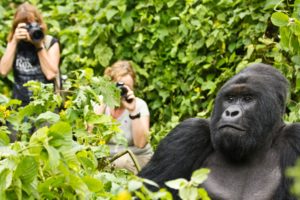
A 7-meter (21 feet) distance should try to be observed at all times from the gorillas. The further back you are, the more relaxed the group will be.
You must stay in tight group whey you are near the gorillas.
Keep your voices down at all times. However, it is okay to ask the guide questions.
Do not smoke, drink or eat when you are near the gorillas. Eating or drinking inevitably will increase the risk of food/drink morsels/droplets falling, which could increase the risk of transmission of diseases.
Sometimes the gorillas charge. Follow the guides example (crouch down slowly, do not look the gorillas directly in the eyes and wait for the animals to pass). Do not attempt to run away because that will increase the risk.
Flash photography is not permitted! When taking pictures move slowly and carefully.
Do not touch the gorillas. They are wild animals.
The maximum time you can spend with the gorillas is one hour. However, if the gorillas become agitated or nervous, the guide will finish the visit early.
After the visit keep your voices down until you are 200 meters away from the gorillas.
General health rules for gorilla trekking:
Remember that mountain gorillas are very susceptible to human diseases. The following rules are ways to minimize the risk your visit might poses to them:
Respect the limits imposed on the number of visitors allowed with the gorillas each day. This minimizes the risk of disease transmission and stress to the group.
If you are feeling ill, or you are carrying a contagious disease, volunteer to stay behind. An alternate visit will be arranged for you, or you will be refunded your money.
If you feel the urge to cough or sneeze when you are near the gorillas, please turn your head away and cover your nose and mouth in order to minimize the spread of bacteria or viruses.
Always stay 7 meters (21 feet) away from the gorillas. This is to protect them from catching human diseases.
Do not leave any rubbish (e.g. food wrappers) in the park; foreign items can harbor diseases or other contaminants.
If you need to go to the toilet while in the forest, please ask the guide to dig you a hole with his panga. Make sure the hole is 30 cm deep and fill it in when you are finished.
What to bring on your Gorilla Tracking Safari:
Wear comfortable hiking shoes suitable for steep muddy slopes.
Put on ear plugs for those who feel uncomfortable with the jungle sounds.
Carry a packed lunch and enough drinking water.
Carry rain gear, sunscreen lotion, a hat (as the weather is unpredictable) and insect repellent.
Bring a photo of film camera. Using flashlight is not permitted so we recommend using films of 400-800 ASA.
For more information about Gorilla Trekking Rules and Regulations, kindly contact our office via email or phone call.
Cookie Consent
We use cookies to improve your experience on our site. By using our site, you consent to cookies.
This website uses cookies
Websites store cookies to enhance functionality and personalise your experience. You can manage your preferences, but blocking some cookies may impact site performance and services.
Essential cookies enable basic functions and are necessary for the proper function of the website.
Name
Description
Duration
Cookie Preferences
This cookie is used to store the user's cookie consent preferences.